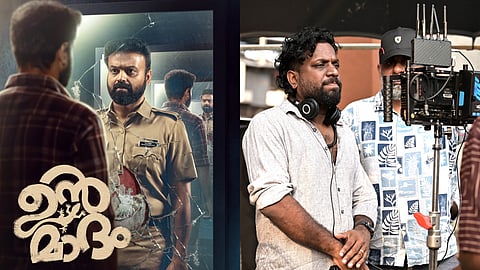

Thondimuthalum Driksakshiyum, Moothon, Ela Veezha Poonchira, Ishq, Joji, Rorschach... There goes some of Kiran Das' standout works as an editor. In his decade-long career, Kiran has collaborated with some of the industry's most prolific talents to shape many acclaimed works from the edit table. Drawing from that wealth of experience, he is now finally stepping out of his editing suite to don the director's hat. Unmadham, his directorial debut headlined by Kunchacko Boban, is up for release on July 31.
In this conversation, Kiran takes us through what it means to be a director after years of approaching films from an editor's perspective, adapting to different working styles and more
Excerpts
After becoming a director, is there something you noticed about filmmaking that you hadn't noticed as an editor?
Direction was never in my plans, even though I've had offers before. As a director, you're supposed to handle a huge team, but I never thought I had such commanding power or leadership qualities. But somehow I was able to do all of it. Long phone calls, script narrations — that too in Malayalam and English — convincing artists and technicians... I haven't dealt with so many people before in my life. In a way, direction has also helped me mingle openly with people. I initially thought I wouldn't enjoy any of this, but as I got into the pre-production and shooting, I realised I can do this. That said, I'm still not very passionate about filmmaking; editing remains my primary focus.
What prompted you to take up Unmadham then?
It again wasn't planned. Some five films I was supposed to edit last year got delayed, resulting in a big break in my schedule. Since my friends had also been pushing me, I thought of giving direction a try. I just wanted to see if I'm talented enough (laughs). Shahi (Kabir) and I initially discussed a different subject that was more complicated and would have required at least a year of research. Since I couldn't spend much time on it, we chose Unmadham, which is a subject I've known for 4-5 years.
Shahi's films generally explore darker themes like psychological trauma, systemic corruption, and oppression. Where does Unmadham belong?
For a change, this is a film with a peaceful ending (laughs). It's not a deliberate decision; the story demanded it. It has real-life inspirations, drawing even from Shahi's own family life. Although it's an investigative thriller, there's also a good dose of family emotions. The script had the right balance.
Editors usually have the privilege of seeing an actor’s raw performances, but curiously enough, you chose to work with Kunchacko Boban, whose films you haven't edited before...
I think I've worked the most with actors like Fahadh (Faasil), but this is not a character that demands such high intensity throughout. He is a simple, ordinary policeman who later undergoes a very evident transformation. We have seen Kunchacko Boban pull off such changeovers wonderfully in films like Nna Thaan Case Kodu and Oru Dhurooha Sahacharyathil. For that changeover to be impactful, it demanded an actor like him, who has that 'paavam' everyman image.
On the contrary, we needed the complete opposite from Lijomol, who is generally associated with 'paavam' roles. She plays his wife, a working woman who can be loud and confrontational.
How different was it working with a corporate studio like Panorama compared to the independent producers you've mostly collaborated with?
I've worked with corporate banners before, but Panorama was different. They had done a detailed study and research, which meant they were well prepared before their launch in Malayalam. I know production houses where something as simple as buying a new hard disk would require days of paperwork and permissions. But in Malayalam, decisions are taken instantly, and Panorama understood that. Since we finished production under the actual budget, they were happy and even extended an offer to collaborate on more projects.
Since you are also an editor, did you shoot economically with a predesigned structure in mind?
Yes, since this is my first film and as part of my learning process, I shot it the traditional way, where you preplan the shots and shoot only what's needed. That helped us wrap up the film ahead of schedule. I also chose to edit the film by myself because we didn't shoot any extra rushes for another editor to create a new perspective.
I've worked with filmmakers following different styles. For example, a film like Joseph was shot and edited very conventionally, with Pappettan (M Padmakumar) having utmost clarity. But you can't replicate that with Thondimuthalum Driksakshiyum, which was developed organically through constant improvisations. As an editor, I've always enjoyed figuring out a film and its narrative structure on the edit table, but it was a different kind of adrenaline rush to see a film evolving during the shooting. You can instantly see the result.
Your filmography reflects a mix of mainstream commercial cinema (Romancham, Upacharapoorvam Gunda Jayan, Palthu Janwar) and niche content (Appan, Jananam: 1947 Pranayam Thudarunnu, Prappeda)...
There's always a preference for films made by those in our friends' circles. Sometimes I get a feeling that this subject will definitely become a hit, and I should be a part of it. For example, I hardly knew Chidambaram or Ganapathi before Jan.E.Man, but I could see its potential. It was also a comedy, which I hadn't worked on much before. Money is another enticing factor. If the pay is hefty and the subject is not horrible or totally irredeemable, I’m up for it. I also like to keep juggling between genres. My editor friends call me crazy for working on two films in parallel, but it's important for me because if I keep editing a project continuously, 'kili pokum' and I lose my sense of judgement. That’s why I edited Rorschach and Ullozhukku simultaneously; likewise, Joji and Jan.E.Man. Just that they have to be contrasting.
Is there a favourite genre, or something you feel is easier to edit?
Realistic cinema. I also enjoy films that can be restructured and rediscovered on the edit table. It can be challenging, but with digital filmmaking, as long as you have enough rushes to work with, there's room to create something entirely fresh. That said, an editor can't do it alone; every department has to work in tandem. Films like Thondimuthalum Driksakshiyum, Joji, and Ishq were made like that.
I also like being involved from the script discussion stage. However, that requires being blunt with your opinions, which may not sit well with everyone, especially writers. Even a single suggestion to remove a scene or a piece of information can disrupt the structure they've carefully built. So I work like that only with those who are open to suggestions, like Dileesh Pothan, John Paul George, and Shahi Kabir. I try to be with them throughout the shooting, assembling what we've shot each day with sound effects and reference music so they can get a sense of how it's shaping up. That's different from spot editing, which is essentially the director's cut. Spot edits are useful for checking costume and action continuity, but they shouldn't be treated as a reference for the actual edit.
Do you think editing is a thankless job?
Not really, editing is actually an invisible job. Imagine you are watching a reel about a daring act. If you see a cut somewhere in between, the believability is instantly lost.
Of course, we all wish for validation. Initially, I used to wish for my name to be mentioned somewhere, but I'm now used to it (laughs).
There are two schools of thought: some believe every craft in a film should blend seamlessly without any overpowering, while certain films need a distinct outlook. Where do you stand?
As long as your work doesn't affect the flow of the narrative, everything is fine. Thallumaala is a perfectly edited film with lots of stylised cuts and effects, but so is Kumbalangi Nights. Editing or any technical aspect of a film shouldn’t be jarring enough to take you away from the film.
