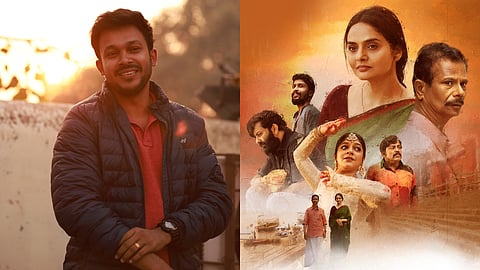

Chinna Chinna Aasai producer Abhijith Babuji still remembers what almost everyone around him said before he began his first production venture. "Don't do this film." Family, friends, they all said it, not because they doubted him but because they knew, as he puts it, "Filmmaking is an extremely risky business." For someone stepping into the uncertainties of producing for the very first time, that risk was hardly abstract. The tender, conversational drama, headlined by Indrans and Madhoo, has just landed on JioHotstar, after a theatrical run that stretched past four weeks, modest by industry standards but, in Abhijith's telling, entirely vindicating.
A city, a story, and a leap of faith
The film's origins trace back to a place rather than a script. "The biggest one was Varanasi," he says of his reasons for producing it. "Varanasi has a very personal connection with me. Whenever I've gone through a difficult phase in life, visiting Varanasi has somehow helped me find clarity." When his college batchmate and now debutante director Varsha Vasudev narrated a story about two people in their fifties over the course of a single day in that city, he recounts connecting with it instantly. Indrans, he felt, was the only actor who could carry that emotional register. Madhoo's casting brought its own resonance, marking her return to Malayalam cinema after a long gap. Abhijith knew what he was getting into. "I knew this wasn't a typical commercial entertainer," he admits. "But I believed it had enough emotional strength to connect with audiences. Even if there had been a small financial loss, I felt it would still have been worth making because it's a film I genuinely believed in."
That conviction met a far messier reality once production began. Abhijith, who describes himself as "essentially a businessman", ploughed roughly a decade's worth of earnings into the film, money that could easily have gone into real estate. "One thing I learnt very quickly is that a film's budget never remains what you initially estimate," he says. "If you start with a budget of 100, you should expect to finish somewhere around 130 or 140." Shooting entirely on location in Varanasi, a city with none of the conveniences filmmaking usually depends on, tested that budget further still. His team spent nearly two weeks scouting before the shoot proper began, physically walking every location. "We traced the characters' journey step by step to understand where the camera should be placed, how equipment could be moved and how each sequence could be executed efficiently," he recalls. The discipline paid off and the film wrapped in 28 days.
Finding the audience that mattered
Dulquer Salmaan's Wayfarer Films came on board to distribute after watching a preview, drawn by the prospect of seeing Indrans in an unfamiliar romantic register, Madhoo's return to Malayalam cinema, and the pull of Govind Vasantha's score against the backdrop of Varanasi itself. Their backing mattered enormously for what he calls "a small film." Abhijith was clear that Chinna Chinna Aasai predominantly caters to viewers who gravitate towards slow-burn, conversational dramas. "It was made for a specific audience, and we focused on reaching that audience instead of trying to appeal to everyone," he says. That extended to marketing spend too. His advice to first-time producers is blunt. "If you make a film with a budget of 100, you should ideally reserve another 20 to 25 purely for promotion. The key isn't to market everywhere. It's to identify the right audience and spend your promotional budget reaching them effectively."
The climax, he reflects, was never in doubt creatively, even if it demanded the most work. Knowing early on that it had to be the emotional soul of the film, the team laboured over the music and staging until the ending landed as heart-wrenching, steering the bond between these two strangers in Varanasi towards a far more quietly devastating close than their gentle day together lets on. "We spent the most time discussing those final eight or nine minutes," he recalls, describing how theatres would fall silent during those scenes. "That silence itself told us we had managed to achieve what we had set out to do."
Lessons beyond the balance sheet
"Money can always be earned again. But if I lose my mental health, my life itself will be affected." That, Abhijith says, was the answer he arrived at when a close friend, Vishnu Chakrapani, put a question to him before a single frame of the film was shot: "If you lose all your money, will you still be mentally okay?" The answer stayed with him as an operating principle throughout production. "Throughout production, I kept telling my director, my wife and everyone around me the same thing. Even if I lose all this money, it shouldn't affect me psychologically."
The film's journey also reshaped his understanding of OTT acquisitions. Early on, intermediaries warned him his promotions were too weak to get noticed without their help. Looking back, he believes much of that was manufactured panic. "The theatrical performance of a film plays a major role in OTT negotiations," he explains, noting that JioHotstar came calling only after seeing how the film resonated with family and female audiences in theatres. His advice to independent producers echoes his broader approach to filmmaking: identify the right people at the platform, present a professional pitch directly, and let a strong theatrical run do the negotiating.
Looking ahead with clarity
Looking back, Abhijith calls the whole experience "highly profitable", both financially and in terms of the lessons it offered. "This film was my education in filmmaking." Born in Paravur and raised largely in Nilambur, he studied mechanical engineering in Thiruvananthapuram before building an education and skills-training business that now operates out of Kochi and Dubai. Cinema, he's careful to point out, isn't his primary income. It's a passion he's chosen to pursue anyway.
That passion now has a second, more commercially ambitious target. His next production is a thriller, conceived with an eye on emotional stories that travel beyond Kerala. "I now want to make a Malayalam film that can engage viewers across age groups with international sensibilities," he says.
