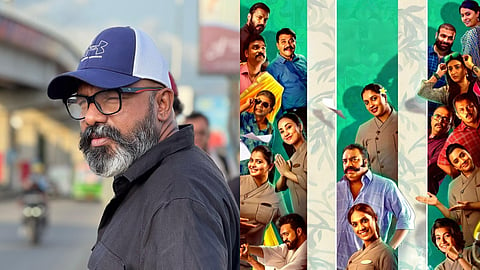


There aren’t many filmmakers of Abrid Shine’s tribe in Malayalam cinema today. He debuted with the commercial blockbuster 1983, a relatively safe, conventional film, but soon veered into uncharted territory. His next, Action Hero Biju, signalled a drastic shift in the realistic portrayal of police stories in Malayalam. He followed it up with a series of distinctive attempts — a film set entirely against the buzzing backdrop of a youth festival (Poomaram), a bona fide martial arts actioner (The Kung Fu Master), a fantasy blending time travel and courtroom satire (Mahaveeryar), and now an A-rated social satire set within the confines of a shady massage parlour (Spa).
He may not always be a box-office darling, but the director has been relentless in his pursuit of fresh, ingenious storytelling. We spoke to him about his penchant for the unusual, the intent behind Spa, balancing craft with commerce, and more.
Excerpts
Spa is receiving a polarising response, with many praising the craft while others dismissing it as just another adult comedy, pointing to the ‘happy ending’ scenes. Did you expect this?
We were disappointed on the first day because people were dismissing the film without acknowledging its narrative graph and character detailing. It was projected as though the film only had ‘happy ending’ scenes. In reality, that appears only thrice, and that too after about 40 minutes.
People were laughing and enjoying the film inside the theatre, but once they came out, they belittled it. Gradually, though, more nuanced reviews are coming in — readings that engage with the film more deeply. The footfalls are encouraging now, especially in urban centres.
You had mentioned that actors like Janardhanan and a few others backed out at the last minute because of the film’s adult nature. How do you extract performances while dealing with morally ambiguous or socially uncomfortable themes?
With this film, costumes were the biggest concern. In a spa, you’re normally expected to wear a disposable brief, and some actors were unsure about that and opted out. Major Ravi sir and Radhika (Radhakrishnan) also had their reservations, but eventually everyone who agreed to act trusted me.
I even warned them that it’s an A-rated film and their families might not approve. But since I’m also a photographer, they were convinced about my aesthetic sensibilities. In fact, Mahaveeryar got a U certificate despite having a full-frontal nudity scene because the censor board officials were convinced it wasn’t vulgar.
The women in Spa are refreshingly unapologetic, without being bound to stereotypes of poverty or trafficking…
We’ve already seen films like Chandni Bar, Sadak, Soothradharan, and Abhimanyu, where the hero rescues vulnerable women. I didn’t want to repeat that template. That’s why Riya (Radhika) doesn’t pay heed to Maathan’s (Vineeth Thattil) repeated attempts to “rescue” her. I liked how the Oscar-winning film Anora subverts this trope and goes beyond the usual sympathetic portrayal of a sex worker. I came to know about that film from Rajshri Deshpande just before we went on floors.
One of Spa's highlights is how it exposes moral hypocrisy and social double standards without reducing itself to moral posturing…
The intention was never to deliver a moral verdict, expose anyone, or change the world. I only attempted to make an entertaining social satire about people of various shades converging in a space like a spa. Everyone here is grey, including the women and those who visit them. It’s a world of illusion and lies, where everyone wears some kind of mask and is unwilling to reveal themselves completely. I felt such a scenario would create fun interactions with deeper meanings. Beyond that, I never wanted to hurt or look down upon anyone. The audience is free to interpret it however they wish.
What’s your take on the Thiruvananthapuram corporation’s decision to enforce bans on cross-massaging?
It’s an administrative decision with legal ramifications. I think it’s better not to share an opinion without fully understanding it.
Many felt the ending didn’t land as intended, especially the purpose of the two assassins and their standoff…
My story was simple: a shootout happens in a city spa. Who all visited that day, and what unfolded between them? Maathan is the bridging character, and ideally the film ends with him breaking down after Riya refuses him. But that wouldn’t make for a fitting finale.
The film is about the collision of morally double-faced individuals within a fictional space and the internal tensions that accumulate there. In the end, that tension had to explode kinetically. That’s why I introduced the assassins cinematically, in slow motion. There’s no genre shift, only a genre blend. They’re treated comically, hence names like ‘Bikini Killer’ and ‘Massage Killer’. They exist to raise the tempo in the final movement, to create a musical and structural crescendo. Without that energy, the collapse wouldn’t feel complete. The gunfire is surface noise; the real explosion is Maathan’s inner collapse. While chaos unfolds outside, Maathan is crying for love inside. The climax lies in that contradiction.
You’re known to break away from conventional screenplay structures, as seen in Action Hero Biju, Poomaram, and now Spa. Do you think audiences are welcoming of it?
Our audience is most familiar with the three-act structure, which has existed since the fourth century. Even though there are alternative storytelling forms, we’ve always preferred this popular structure. Whenever someone tries to move away from it, there will be resistance. But I believe audiences will eventually embrace fresher attempts. I experienced that with Action Hero Biju.
How and when did your tendency to experiment begin?
I don’t deliberately experiment or break rules. The Kung Fu Master, for instance, is a revenge film with a typical three-act structure. I move away from traditional forms only when a story demands a different approach. The only thing is, I’m not afraid of what might happen if I steer clear of the norms.
It began with Action Hero Biju, which was initially written in a conventional three-act format. At the time, I had no idea how a police station or an officer functions. When I studied it, I realised their job requires them to juggle multiple emotions constantly. One moment they’re recovering a mutilated body from a railway track, the next they’re having dinner, settling a petty quarrel, or rescuing a child from a well. Unlike the films I had seen, a policeman’s job isn’t to destroy a single villain, but to solve countless everyday issues. That was an eye-opener. I realised not many had attempted a film like that. So Action Hero Biju helped me break rules — not intentionally, but organically.
Box office results haven’t always favoured you. Does that bother you?
Of course it does. If you can’t recover the investment, you’ll naturally feel disappointed. That’s why I try to minimise budgets. I’m not a rebel who disregards box office prospects. I’m simply trying to entertain people by doing something new each time.