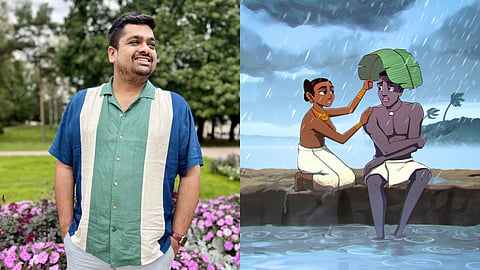

There is a certain quality of courage needed to venture into uncharted territory, not the swagger of one who is nonchalant about failure, but the measured courage of a craftsman who knows exactly what he does not yet know. Rahul Riji Nair, the National and State Award-winning director of Ottamuri Velicham and Kalla Nottam, is one such person. His latest work, a short titled Kingara Kavyam (Poem of the Enslaved), marks his debut in animation, premiering at the 3rd edition of AniMela, India's first international festival dedicated to Animation, VFX, Gaming, Comics, and XR, in Mumbai from February 19th to 22nd. Set in 17th-century Cochin, it follows Kappiri, an African slave, and Kunjala, a local woman from the oppressed class, as they find each other across rigid boundaries of race and caste, their quiet bond threatened by the cruelties of the world around them. One of eight films chosen for the South Asia Competition.
An idea born out of lockdown
Kingara Kavyam took shape during the pandemic, when cinema itself felt uncertain. Rahul, with a background in live action, began to wonder whether the medium he had built his career in could survive at all. "The idea came about during the lockdown. None of us knew what the future of cinema would be. Animation was completely new for me. I began to think about whether I could tell a story through animation instead," he says. He wrote the first draft during those months, then discovered how different the two crafts really are. In live action, you record first and refine later. In animation, sound design, music, and dubbing must exist before a single image is created.
He turned to YouTube tutorials, friends in the industry, and taught himself both formats more or less from scratch. Budget and intuition settled the style. "I thought 2D was better suited for the story," he says. Two years ago, he found Carmond Infinity, a Kochi-based studio whose 2D work complemented his strengths, and the project became a co-production in December 2023. "It has taken nearly two years of learning, storyboarding, experimentation, and coordination to reach this stage," he recounts.
A visual language rooted in Kerala
The film's visual style draws from Kerala's temple mural tradition, a choice that was partly artistic, partly strategic. "When we started, AI-driven animation and image generation were not yet widespread, but I could see it coming. We needed a unique artistic identity that would stand apart from machine-generated visuals. That pushed us to explore something rooted in culture," he says. Traditional mural art is detailed and static... bringing it to animation took months of experimentation.

Kappiri Muthappan and forgotten histories
The story draws from the lore of Kappiri Muthappan, a deity worshipped near Fort Kochi. When the Dutch arrived on the Kerala coast in the 17th century, the Portuguese fled in a hurry, burying their wealth in various locations. Into each pit, they lowered not just their treasure but one of their enslaved Africans, brought from the East African coast, burying them alive to stand guard over it. Over time, that cruelty passed into faith. The enslaved became protective spirits, and 'kappiri' became Kappiri Muthappan, a god. It is the history inside that legend, largely absent from mainstream consciousness, that drew Rahul in. "It's a documented fact that there was a slave trade in Kerala, but it's rarely discussed in popular media. We often hear about slave trade histories in North America and Europe, but very little about our own region. That absence intrigued me," he recounts.
A love story built on silence
For all its historical weight, Rahul insists the film is fundamentally a love story. "At its heart, this is a love story built on silence. The two central characters don't share a common spoken language. But what they do share is an emotional language, silence. It is within that silence that they recognise each other's suffering," he explains. One carries trauma from afar, the other belongs to a marginalised community in Kerala. Their connection grows through shared pain rather than dialogue. Animation, he notes, also gave him a freedom that live action rarely would. Depicting Kunjala with historical authenticity meant portraying her bare-chested, as was the norm for lower-caste women in 17th-century Kerala.
Animation in Kerala
Rahul describes Kerala's animation ecosystem as a paradox. The talent is abundant. The structure to sustain it is not. "There are countless Malayalees working in major animation studios across the world. The talent pool in Kerala is strong and undeniable," he says. What is missing, he explains, is the business framework. "Animation is still a niche sector here. Many studios survive purely out of passion. There is no clear market convention or structured commercial model in Kerala that consistently supports animation features," he says, admitting he has no clear answer himself when it comes to Kingara Kavyam's own break-even plan.
The audience is not the problem. He points to Demon Slayer filling early-morning shows across Kerala like a superstar vehicle and mythological animations like Mahavatar Narsimha collecting hundreds of crores. Major franchises, including Baahubali, are expanding into animated spin-offs, he notes. "I believe in the next three to four years, animation in India will grow significantly. In Kerala, we have the talent and the audience. What we are missing is the commercial bridge between the two," he reflects.
That bridge is personal for Rahul, too. Directing a Malayalam animated feature is one of his biggest ambitions now, and his team has already begun preliminary development. He draws quiet inspiration from unlikely places. Latvia, a small country without a massive animation industry, produced Flow, which went on to win the Oscar for Best Animated Feature. "That shows what is possible," he reflects. Platforms like AniMela, he feels, are precisely what the ecosystem needs, opening South Asian animation to global audiences and industry eyes alike. "The business possibilities are huge," he says, "if we can build the right support system."