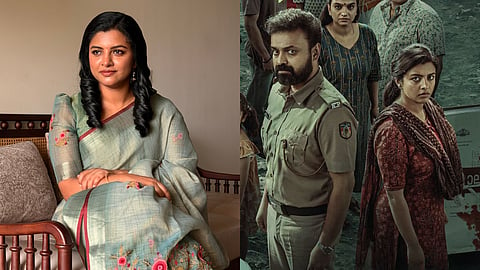

A decade after Dileesh Pothan-Fahadh Faasil's Maheshinte Prathikaaram introduced her to audiences, Lijomol Jose continues to follow her own path as an actor in both Malayalam and Tamil. Her filmography has never been about quantity, but about finding characters she can believe in. Not every film has travelled the same distance, but her characters often have. From Senggeni in her breakout film Jai Bhim to Steffi in Ponman, emotionally layered women have largely been the roles that have come her way.
Her latest film Unmadham continues in the same vein. As Soumya, the frustrated wife of Kunchacko Boban's aspiring screenwriter-cop, she lends emotional depth to a character navigating the strains of marriage, responsibility, and an uncertain life. In this conversation with us, Lijomol opens up about building Soumya from the inside out, collaborating with Shahi Kabir, Kunchacko Boban and director Kiran Das, her evolving choices as an actor, and her hopes to explore lighter, more carefree roles.
Excerpts:
What made you say yes to Unmaadham and the character of Soumya?
One of the biggest reasons was simply the name Shahi Kabir. He's a writer who observes people with so much empathy, and the films and characters Shahi ikka has created make actors want to be part of his world. That was my first excitement. But beyond the name, I still had to be convinced by the story and the character. If I can't relate to a character or understand why they behave the way they do, I can't perform them convincingly. I also loved that this was a very different kind of police story from Shahi ikka's earlier films. Then there was the team: editor Kiran chettan making his directorial debut and my first collaboration with Chackochan.
What were your conversations with Shahi Kabir and Kiran Das like while building Soumya's emotional journey and the reasons behind her anger?
When I heard the story, I understood Soumya immediately. I think women who go out to work, especially primary earners, will relate to her more. There are many families where women carry the financial responsibility while their partner continues chasing a dream, as Shelly does. Soumya represents many of those women. Kiran chettan and Shahi ikka constantly explained why she reacts the way she does. Every outburst has a reason.
As an actor, I had to carry everything she had been through into every scene. She's running the household almost single-handedly, managing work, finances, children and daily responsibilities, without the emotional support she needs. When someone carries so much alone, frustration naturally builds up. That's why she gets angry, and I think many women will understand that.
How was it working with Kunchacko Boban?
Working with Chackochan was one of the nicest parts of the film. Acting is never something you do alone. Every scene is an exchange, and what your co-actor gives you directly shapes your performance. Because he performed Shelly with so much honesty, it became much easier for me to respond as Soumya. Off-screen too, he's a wonderful human being.
How did knowing that Shahi Kabir had drawn from his own relationship with his wife influence the way you built Soumya?
Shahi ikka had mentioned after the narration that some situations were inspired by experiences from his own married life. That doesn't mean Soumya is based on his wife or that Shelly is based on him entirely. But certain situations and emotional dynamics came from real life. Even though I was aware of that, I never used it as a direct reference while performing. Instead, Shahi ikka explained the emotional reasons behind every scene in detail. That helped me understand why Soumya behaves the way she does.
Soumya constantly criticises Shelly's dream, yet never stops believing in him. How did you interpret that contradiction?
Of course, Soumya constantly criticises Shelly when she feels he's running away from his responsibilities, but that doesn't mean she's always frustrated or angry. Every outburst has a reason. Take the hospital scene for example. She had already reminded him to pick up their kids from school, but he gets distracted by another appointment and forgets. As a result, their daughter is injured in an accident. Her anger doesn't come out of nowhere.
At the same time, she never asks him to stop dreaming. Right from the beginning, she only tells him not to give up on his job while chasing that dream. She's not against his ambitions at all. She only wants him to be financially responsible while pursuing his dream. Deep down, she still believes in him and is always there when he falls. That's why I think love and frustration coexist in her.

As Lijomol, did you ever feel Soumya was being too harsh on Shelly?
Yes, because I'm actually a very quiet person. I'm not someone who raises my voice during conflicts, so reacting with so much intensity didn't come naturally to me. Even while reading the script, there were moments where I instinctively wanted to play her more softly. But Kiran chettan and Shahi ikka would stop me and say, "No, don't lower the intensity. Keep the character stronger." They would ask for another take if they felt I was underplaying it.
They reminded me that what we see in the film are only selected moments from these characters' lives. There are countless unseen incidents before every scene. Soumya has tolerated many things before finally reaching these breaking points. So when those moments come, she has to react fully.
You once said every film teaches you something about people. What did Soumya leave you with personally?
I think the biggest takeaway Soumya left me with is to be a little kinder. She appears harsh because she's carrying enormous pressure. Towards the end of the film, we learn that Shelly has been living with depression and has been on medication for four years in the end. Looking back, I sometimes wonder if she could have been a little gentler in certain moments. But that's true in real life too.
We often react based on our own emotional state without fully understanding what the other person is going through. There's a dialogue of KPAC Lalitha chechi in Sunday Holiday that has stayed with me: "Ethire nikkunnavante ullonnu ariyaan sremichaal, ellaarum paavangalaa (If you try to understand the heart of the person standing opposite you, you'll realise we're all good people)." If we knew a little more about what another person was carrying, perhaps we'd be kinder towards them.
You've built a reputation for emotionally burdened characters, even though you've said you want to do lighter characters...
Every film changes the kind of opportunities that come afterwards. People watch a performance and approach us with similar roles. Jai Bhim was definitely a turning point for me. It brought far more appreciation than I expected and led to similar offers, but I consciously tried not to repeat myself. Steffi Graf in Ponman was also a layered character, but very different from my role in Jai Bhim. I think every actor wants each new character to feel different from the previous one.
The one in Samshayam was comparatively a lighter character, but films like Nadanna Sambhavam, Baby Girl, and now Unmaadham all have emotionally layered characters. That's simply the kind of roles I'm still being offered. The last truly light-hearted role I played was in Kattappanayile Rithwik Roshan, which came right after Maheshinte Prathikaaram. If someone offered me another Soumya or Steffi Graf, I wouldn't do it. I genuinely want to play lighter characters without so much emotional baggage.
Having said that, none of this was planned. I never entered cinema thinking I wanted to build a career. I simply choose whichever project felt better at that point. Not every film turns out the way we imagine, but I've always believed that if we prove our talent, the right opportunities will come.
You're known to be very private off-screen...
Definitely. Earlier, my job ended after dubbing, but today, especially when I'm one of the leads in a film, promotions have become a big part of my responsibility. Interviews, theatre visits, college programmes and promotional events are all part of the job. The problem is that I'm not naturally comfortable with any of it. I'm just an individual who happens to be an actor, and crowds make me anxious. Even now, theatre visits and public events make me nervous because I know everyone is looking at me. But I have to face it. I'm training myself every day. I haven't completely overcome it yet, but I'm still learning.
I'm also not someone who feels the need to constantly update people about my daily life on social media. I'd rather let my work speak for itself. When I'm not working, I prefer to go back to my private life. Sometimes I wear a mask when I go out because it lets me move around quietly. For someone with a personality like mine, all this can be difficult, but it's something I've had to learn to live with.
What are the future projects you're most excited about at the moment?
There's Aja Sundari, alongside Joju (George) chettan and two child actors. It's another editor's directorial debut, this time by Manu Antony. It has a very interesting premise, and as the title suggests, a goat also plays a major role in the story. That should be my next release in Malayalam.
Then there's a Tamil film produced by Atlee, which reunites director Balaji Tharaneetharan with Vijay Sethupathi. It's a period film set in the 80s and 90s, and also has other Malayalam actors like Santhy Balachandran and Vishnu Govindan.