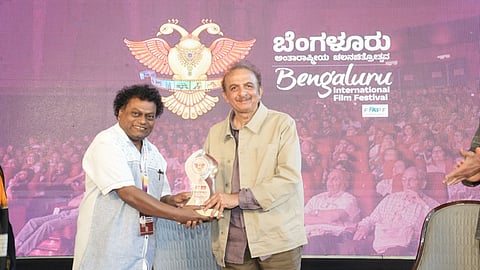

Noted writer and lyricist Jayanth Kaikini said that lyric writing is an art that emerges from the subconscious and cannot be taught through training or workshops. Speaking at a session during the 17th Bengaluru International Film Festival, Kaikini shared his views on writing film songs, stressing that one must read Kannada poetry and literature and closely observe everyday life to develop writing skills. According to him, lyric writing is similar to abstract images that appear in dreams and cannot be mastered like direction or acting through formal training. He added that excessive training often makes creative work look uniform, comparing it to bodies shaped similarly in a gym or brides who appear identical after visiting a beauty parlour. To leave a personal signature in writing, he said, one must learn to write independently.
Kaikini also spoke about the inevitability of change, stating that it is wrong to assume that the past was better than the present. He said time, people, and technology constantly evolve, and individuals must adapt accordingly. Reflecting on his own journey, he revealed that he became a film lyricist only at the age of 52, despite being a lifelong admirer of film songs. He recalled how he grew up humming songs and mentioned that his father used to say humming is better than grumbling. In his younger years, he focused on serious literary works such as Kotiteertha, and later transitioned into writing film songs.
He admitted that he initially underestimated the difficulty of writing film lyrics, assuming it would be easy, but later realised the challenges involved. In cinema, lyrics must fit pre-composed tunes and meters, which he described as a demanding process. He noted that with millions of songs already existing, it is difficult to create something unique, especially when nearly 97 percent of songs revolve around love. Repeated use of common words associated with love makes it harder to create fresh expressions, which he described as one of the biggest challenges for lyricists.
Kaikini said he never neglected his other literary pursuits while working in cinema and continued writing stories and poetry. He observed that many young listeners who discovered him through his songs later began reading his books, leading to reprints of his literary works. He traced his love for cinema back to his childhood, crediting the touring talkies in his hometown for nurturing his fascination with films. Quoting Javed Akhtar’s remark that cinema is like a religion, Kaikini said that cinema has shaped many ideals in Indian society. Drawing a parallel with the famous dialogue from Deewaar, he remarked that if someone asked what he possessed, he would proudly say he has cinema.
He also spoke about writing songs for the Kannada dubbed version of Ponniyin Selvan, calling it a challenging experience. The two-part film, composed by A.R. Rahman, features 14 songs. Kaikini said he informed director Mani Ratnam that he does not prefer literal translations and would instead write original lyrics if given creative freedom. He said Mani Ratnam allowed him to write independently after explaining the situations in the film. Recalling a humorous moment, Kaikini said that in Kannada, words for love such as “preeti” or “prema” require lips to touch while pronouncing them, whereas the Tamil word “kaadhal” does not. He jokingly asked Mani Ratnam how love could be expressed without lips touching.