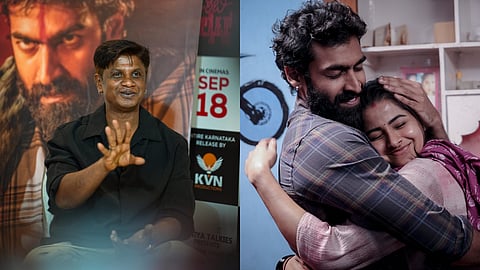

Vijay Kumar’s cinema has never averted its gaze from blood, grime, or Bengaluru’s margins. Following Salaga and Bheema, his third directorial venture, City Lights, explores fragile territory: innocent love colliding with an unforgiving metropolis. In a candid conversation, ahead of the film's release on September 18, the filmmakers gets candid about mapping Majestic’s raw underbelly, directing his daughter Monisha, and his creative bond with Vinay Rajkumar. Weighing in on the pan-India debate, he discusses craft and social accountability over sanitised 'A' certificate cinema.
Excerpts:
Your previous films unpacked crime syndicates and narcotics. What space does City Lights explore?
Every city has a shadow people walk past. For me, City Lights begins at Majestic. It is about innocent souls who land there and get caught in the machinery of an unforgiving metropolis. When others look at Bengaluru, they see a certain silhouette; my gaze focuses on vulnerability, especially the pain of young women arriving with blind trust. While balancing romance and crime, it asks a fundamental question: What happens if each of us resolves to stand up and shield them?
You spent extensive time conducting field research before finalising the film's screenplay...
I recorded hours of interviews documenting lives society prefers to render invisible—beggars, sex workers, transgender communities. Listening to them talk about survival gave my screenplay its spine. Why shouldn't I tell these stories? My only currency is truth: I hold up a mirror to the reality out there.
Directing your daughter, Monisha, in her debut must have been a delicate tightrope...
On set, paternal love exists, but as a filmmaker, my lens must remain objective. Monisha is young. My job was to gently guide her into the emotional core of a scene, whisper ‘Please, live this moment,’ and pull her back out once the shot was done. I didn't want to mould her into a conventional ‘heroine’. I want her to be recognised as a true performer. My dream is to see her earn State and National recognition.
Did knowing your daughter's emotional pulse make coaxing those performances easier?
I know where her tears reside, what sparks her laughter, and what triggers her anger. She might not even realise when I am steering her towards an emotion, that is the quiet alchemy of direction.
There was chatter that she looked ‘too sweet’ for a gritty urban saga...
In people's heads, poverty or vulnerability has an aesthetic blueprint. How can you judge a character's lived experience by social media photographs? I have moulded her to the exact demands of this narrative. Once audiences watch her on screen, she will win their hearts.
There is an obvious fondness you share with Vinay Rajkumar. How did that translate into your director-actor equation on set?
He is the good boy, and I am the bad boy! It is like positive and negative poles meeting. We share a genuinely close relationship and friendship. Sometimes you just have that vibe match; our bond goes far beyond cinema, and it’s a connection that is never-ending. He is a good actor and a deeply good human being, and that was very important to me. When an actor understands real pain and emotional depth, their craft naturally elevates as they gather life's scars. That maturity transforms a performance, and Vinay truly brings that through his performance.
How do you approach the visuals and sound design here?
In cinema, a composer can articulate monumental emotional weight in two minutes flat, and this film has such compositions by Charan Raj. For framing, I don’t believe in sterile sets. I stand on street corners in Majestic, sit on the pavement, and soak in the atmosphere. Realism is built from dust and atmosphere, not studio plaster.
Given the gritty themes, how do you view adult censorship with the film certified with an A?
This film is not for kids below 13, and anyone 16 and above should watch with parents' awareness. But turn on social media or streaming platforms, and unfiltered violence floods screens without censorship. Cinema carries accountability. If Salaga was an unfiltered autopsy of gangland rivalries, Bheema took a stand on narcotics, and law enforcement cracked down heavily on peddlers. City Lights explores the volatile 18-21 bracket where infatuation is mistaken for love, decisions are impulsive, and one reckless step can derail a life.
Is there an embedded cautionary note for youth migrating to big cities?
Do not blindly abandon home and run towards metropolitan hubs like Bengaluru without understanding what lies waiting. Behind the dazzle, predators, trafficking rings, exploitation, and organ rackets exist. When trust is weaponised against an innocent, survival becomes brutal. City Lights is about this.
Where do your ambitions lie regarding ‘pan-Indian’ Kannada cinema?
I am only directing my third film; I don't harbour hollow grand ambitions. You cannot manufacture a pan-Indian film merely by announcing it. If a story is rooted deeply and honestly in our soil, audiences across regions will seek it out. With capital, you can buy grand sets and spectacles, but you cannot buy a soul or a story. That demands honest toil.
