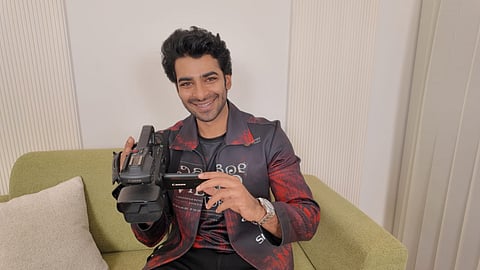

Deekshith Shetty is entering a new phase in cinema. While his acting slate continues to expand with Bail, alongside Shivarajkumar, an upcoming multilingual project in which he shares screen space with Dulquer Salmaan, and Dia director Ashoka's next, the actor is also taking his first step behind the camera as a producer. With Srinidhi Bengaluru’s Video, releasing on September 11, Deekshith has made a particularly personal investment\. He has used the money he had saved to construct a house. For him, the decision is less about adding 'producer' to his resume and more about creating the kind of opportunity he once received.
Why did you want to turn producer with Video?
I think I know nothing other than cinema. Whatever I do, I want to be part of the process of making cinema. When I heard this story, I wanted to be part of it, but I couldn’t be the actor because I wouldn’t fit into the script. So I started thinking about how I could support it. Sometimes you don’t think too much in the heat of the moment. Something triggers you and you say, 'Okay, let’s do this.' That is how Video happened. I had actually saved some money thinking I would use it to construct a house. But I decided to put that money into this film. It is a risk, definitely, but I believed in the story and the people making it enough to take that risk.
Was Srinidhi’s experience with Blink also a reason you wanted to back him?
When I was working in Telugu and Tamil, I noticed that many directors started with very small films. They proved themselves and then, for their second film, they got bigger productions, bigger stars and bigger opportunities. I always had this question: why doesn’t that happen enough in Kannada? Srinidhi and I have known each other since a long time now. When he made Blink, it was critically appreciated and people who watched it on OTT loved the concept. But when he wanted to mount his second film, which was again unconventional, there weren’t producers coming forward to back it. I felt that wasn’t right. And I’m not saying this only about Srinidhi. There are other directors who have made a mark and still struggle to mount their second project. So I thought, okay, let me back this project.
You have also spoken about wanting to give back to the industry. Where does that feeling come from?
I have a lot of gratitude towards this industry. I don’t have a plan B or a second source of income. For 13 years, this industry has taken care of me and my family. Everything I have done is through the money I earned from cinema. So I kept asking myself, how do I give something back?
I don’t think gratitude has an age. When the opportunity comes, you should be ready to give back. When I was selected for Dia, I was nobody. Someone gave me that opportunity, and that first film helped take me forward. Today, when I see youngsters like Bharath Tejas and Jeevan, who worked with me in Blink, I know how talented and hardworking they are. I have heard about their struggles to get the right opportunity, and I felt I could create that opportunity for them.
Has producing changed the way you look at your own acting career?
Definitely. You realise that a film doesn’t work because of one person or one department. A good story is only the beginning. You need the right execution team. Direction, acting, production, music, cinematography, editing, everything has to come together.
My own acting slate is also expanding, with my presence across languages. So I am still very much an actor. But producing Video has made me understand the other side of cinema. When everyone puts their heart and soul into the film, that is when the film becomes what it is.
