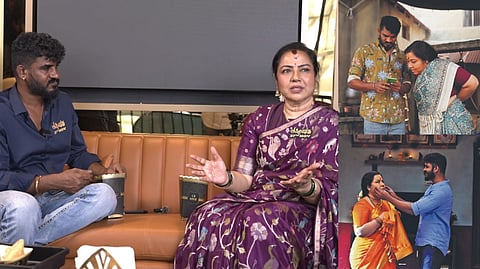

Though versatile actor Tara and our very own Chikkanna both appeared in Kirataka years ago, they never shared a single frame until Lakshmi Puthra. Written and produced by AP Arjun and directed by debutant Vijay S Swamy, the middle-class family drama arrives in theatres on November 27, promising plenty of laughs before delivering an unexpected emotional turn.
Speaking about their on-screen pairing, Tara notes that they avoid the familiar Indian cinema mould of the endlessly weeping, self-sacrificing mother. "We were both part of Kirataka, but we never had scenes together," Tara says. "Here, we play mother and son, yet nearly 90 per cent of our scenes are comedy. We behave more like friends, pulling each other’s legs, until the final turn reveals the real depth of our bond."
On working with Tara, Chikkanna says, "Working with Tara amma felt completely effortless because she brings so much warmth to the set. Off-camera, she talks non-stop, keeping the whole unit lively, and the moment the camera rolls, she switches into character without missing a beat."
Having completed over four decades and 250 films, Tara rarely joins the social media trend of celebrating career milestones. "Honestly, I haven’t kept count," she laughs. "I only know how to keep working. The people who love and support me celebrate those milestones on my behalf. Even today, when I stand before the camera, it feels like I just started yesterday."
Much of the honesty she brings to maternal roles comes straight from her late mother. "Almost every single dialogue in Lakshmi Puthra brought her back to me," Tara recalls. "My mother had zero worldly pretensions. Whenever I took her to interviews and tutored her on what to say, she would go on stage and say something completely different."
That eye for natural performance is also why Tara holds comic actors in high regard. "Any comedy actor is the best actor," she says. "Making people laugh is the hardest job in cinema. Slip by a fraction and it turns vulgar, or falls completely flat. Whether it was Charlie Chaplin, Narasimharaju, or NS Rao, their range was extraordinary." On the sets of Lakshmi Puthra, Chikkanna was initially nervous about how audiences would take his emotional scenes, often walking up to Tara after serious takes to ask softly, 'Amma, okay-na?' Tara responds,"I kept asking AP Arjun and director Swamy why they even doubted him. He doesn’t over-rehearse or construct a performance; he absorbs the moment and reacts naturally."
For Chikkanna, stepping into solo lead roles after Upadhyaksha comes with a clear sense of responsibility. "I look at it like a politician’s election," he explains. "People elect an MLA once out of goodwill; winning the second time depends entirely on the work you do. I know I am neither a mass hero nor a romantic hero who enters with two fight sequences. Audiences don’t buy tickets expecting Chikkanna to make them cry; they come to laugh. In Lakshmi Puthra, they will laugh all the way through and end up in tears without expecting it."
While audiences associate him with non-stop energy on screen, Chikkanna admits he is quiet off-camera. "My friends think I’m boring when we hang out because I barely speak," he says. "My comedy only switches on when a writer gives me lines and the camera rolls." He also credits director Vijay S Swamy, who worked as AP Arjun’s co-director for 15 years before helming Lakshmi Puthra, for anchoring the film. "Someone who has spent 15 years managing a film set isn’t a newcomer to the craft, and a director’s first film always stays precious."
In an era dominated by five-minute social media reels and growing talk around artificial intelligence in filmmaking, Tara admits she feels uneasy about AI encroaching on creative jobs, yet remains certain about the power of theatrical cinema. "Cinema is like music," she says. "No matter how many variations you create, you always return to the same seven swaras. Watching a film in a theatre with strangers, laughing and crying together, creates memories that stay for life. Mother-son emotion and genuine laughter will never go out of style.
