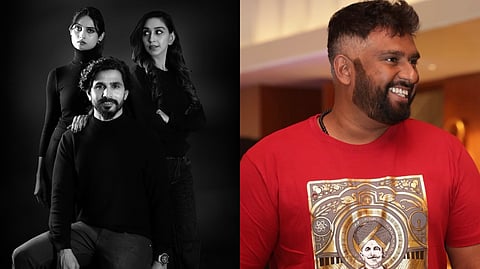

Some filmmakers return to the same genre because it is commercially safe. Then there is director Suni, who keeps returning to love because he is still trying to understand it. Across his career, romance has remained the common thread. But what has changed is the lens. The wide-eyed innocence of Simple Agi Ondh Love Story is not the same as the emotional complexity that coloured his later films. With every project, Suni appears to have arrived at a slightly altered understanding of relationships, and his upcoming Moda Kavida Vaatavarana, releasing on June 26, seems to be his latest meditation on the subject.
Translated loosely as “a cloud-covered atmosphere”, Moda Kavida Vaatavarana immediately evokes uncertainty. The posters do the same. Unlike the bright-eyed optimism associated with many of his earlier romances, these visuals seem drenched in ambiguity. Is this a love story painted in shades of grey? “I am glad you recognised our posters. Every poster and every title has a bigger meaning behind the film,” he says, adding, “There is love in this story, but even a beautiful person who appears perfect on the outside could be carrying pain within. Some emotions remain unexpressed. The film explores those feelings.”
It is tempting to call these the grey shades of love. Suni, however, sees them as part of the same emotional spectrum. His fascination lies not in whether love is black, white or grey, but in how people carry emotions they rarely articulate. The cloud in the title is less about darkness and more about what remains hidden. That thought becomes particularly relevant in an age of dating apps, fleeting attention spans and digital relationships. Yet Suni remains convinced that while methods of communication have changed, emotions themselves have not. “Gen Z may express themselves through statuses, messages, or social media. Sometimes they may not express anything at all. But emotions have not changed. Friendship, affection, love, and longing remain evergreen,” says Suni.
That belief in emotional authenticity also explains the casting of Sheelam M Swamy, who headlines the film alongside Moksha Kushal and Saathvika. Sheelam has been a long-time associate of Suni, spending more than a decade working behind the scenes before finding himself at the centre of this story. “Sheelam came as a software engineer with dreams of becoming an actor,” recalls Suni. “He has been with me for over ten years. During the lockdown, when this script was taking shape, I would constantly discuss it with him. I had narrated the story to a few stars, and Sheelam would accompany me for those meetings. At one point, I felt, why am I looking elsewhere when this character is right here?”
Despite having worked with established actors, Suni has consistently introduced fresh faces. He believes newcomers bring a different kind of flexibility to intimate stories. “With stars, many things are already in place, including the business side. But newcomers can dedicate more time to a project. More importantly, simple stories thrive when actors do not carry pre-existing images.”
He cites Rakshit Shetty and Rishi as examples of actors he supported without considering their backgrounds. “I never look at where somebody comes from. They may enter as professionals, but eventually they become family,” says Suni.
That willingness to trust fresh talent mirrors his willingness to take creative risks. The risk, he says, lies in trying to be different with each story. Looking back, Suni sees his filmography as a series of experiments rather than a carefully planned career graph. “After Simple Agi Ondh Love Story, I made Bahuparak. Then I returned to Simpllag Innondh Love Story. After that came Operation Alamelamma, Bazaar, Chamak, Sakath, Avatara Purusha, Ondu Sarala Prema Kathe and Gatha Vaibhava. Every story demands something new. That itself is a risk.”
As a producer, Suni also understands cinema's economics. “I know profit and loss. But cinema on the big screen is beyond calculations. Today, publicity costs have become enormous. We need better cinematic education and stronger partnerships. Whenever I partner with a producer, I tell them I approach a film with zero expectations. Only then can we truly enjoy whatever success comes our way,” says Suni.
Produced under the Ram Movies banner by Mysuru Ramesh, Srirangaraju, Lokesh Belavadi and Goa Ramesh, along with Simple Suni, the film arrives with measured expectations from its director. “One Friday can change everything,” says Suni, adding, “I have never claimed every film of mine is perfect. But when audiences connect emotionally, nothing can stop a film.”
And perhaps that is what continues to explain Suni's career. Successes, failures, experiments and reinventions have all come and gone. The search for a new way to speak about love, however, continues. In Moda Kavida Vaatavarana, Suni seems less interested in the sunshine and more interested in the clouds. Not because romance has become darker, but because he has discovered that every heart carries the weather of its own. As he signs off, he hopes those clouds bring a silver lining by leading audiences into theatres.
