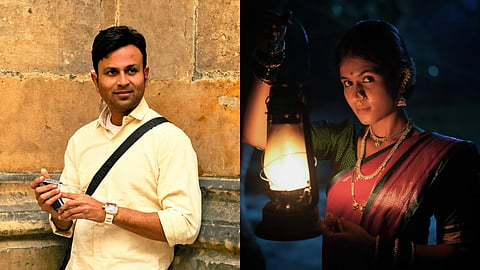


When it was announced that debutant director Santosh Davakhar’s Gondhal is India's official entry for Best International Feature Film at the 2027 Academy Awards, it sparked a familiar debate. Many argued that an independent film like Gondhal cannot compete with big-budget productions, especially in those all-important Oscar campaigns. Admitting that bigger films do have better Oscar prospects, Santosh points out that the jury decides based on merit and not money. “How can one argue that it does not deserve to be India's Oscar submission without even watching the film? Such arguments stem from personal biases. After all, if one film is chosen out of 33, some would naturally feel bad about the rest of the titles.”
The director further explains that a realistic approach to filmmaking is necessary for international recognition. “Our audience understandably wants hero-centric entertainers with typical commercial elements. They like it when the protagonist walks unscathed through a hundred armed men with a rifle in hand. If you take such films to international avenues, they would laugh at them. Internationally, stories should have a realistic touch, making the audience feel like they are reading a novel. There, too, there are several commercial films, but these never win any Oscar awards,” says Santosh, who is also grateful to cinephiles for appreciating Gondhal during its recent re-release.
One of the central themes of Gondhal is the role of women in a patriarchal society. Gondhal’s protagonist, Suman (Ishita Deshmukh), has enough agency to deal with all the malice and injustice around her. As Santosh explains, “She does not openly challenge patriarchy in the film. But what she does to be with her lover can feel radical in our country." The film even opens with an unassuming yet single-take scene of a man and his grandson walking to attend Gondhal, a ritual featuring folk music and percussion that summons deities to bless newlyweds. Explaining the decision to film the first scene in one take, the director reveals, “In my childhood, I also used to walk to Gondhal with my grandfather. I wanted the audience to see that moment from the boy's point of view. Continuity allows for better immersion into the story in terms of emotions, which is why I left it uninterrupted.”
Gondhal also uses visual juxtaposition effectively, cutting between the ritual and the characters' misdeeds to suggest that blind devotion without any morality is a hollow practice. The film has an open ending, leaving the audience to wonder whether the deities have answered the prayers or whether the religious practitioners have become ‘enlightened’ enough to take matters into their own hands. Calling himself agnostic, Santosh says that while Gondhal challenges traditional notions of the divine, he avoided taking a definitive stance. “If I spoon-fed the audience, it would not pique their interest or entertain them. There would not be any discussion around the film. Also, I did not want to impose my belief on the viewers," he says.
Santosh also addresses the critical response to the depiction of child abuse in Gondhal. “I understand that it can be traumatising for the viewer, but the film only shows the truth. The boy does not even understand what has happened to him. The perpetrator knows the nuances of the situation, not the survivor. Our films rarely explore child abuse,” says Santosh, who offers a fascinating insight into the exploration of the theme and the inciting incident. “When the abuse happens, the God in the ritual is asleep while the demon is awake and the characters forming the audience laugh at it. When the Gondhal crew sings, ‘God please wake up for bad deeds are happening here,’ the Raakshas dances and it represents the abuser.”
Another highlight of Gondhal is the music by Ilaiyaraaja, which Santosh calls ‘minimalistic’. While the legendary composer is known for consistently collaborating with newcomers, he is also labelled 'arrogant' for his off-hand comments. Noting that these unfair labels are often thrust on deeply knowledgeable veterans like Ilaiyaraaja, Santosh says, “He listens to everyone carefully and is quite passionate about his work. He listened to every suggestion I made, and even travelled to Sinnar to see the ritual before deciding on the background music. For a few minutes' worth of music in the film, he was with us for two weeks. He also composed the song in just five minutes, which was mesmerising to see.”
Recalling how he first approached the composer, Santosh shares, “I am not sure if he knew it was my first film. All he asked was: ‘Why does Gondhal require my music?’ I told him I wanted to take the film to the Oscars, and he immediately agreed to be part of it. He did not even charge me for the film, except for the studio expenses.”
Looking ahead, Santosh says that an OTT release is part of the plan for Gondhal, although the director is focusing on the film’s theatrical re-release, the festival run, and, of course, keeping an eye on the ultimate prize.