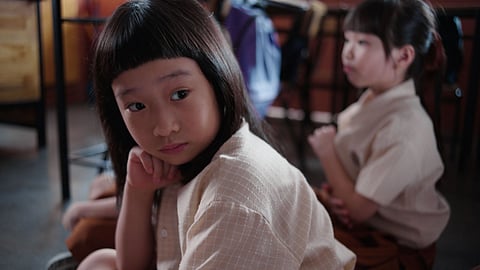

Around the world, child actors rarely receive the recognition they deserve, particularly at award ceremonies. Yet, of late, young performers, especially girls, have been delivering some remarkable work. Following British actor Molly Belle Wright in Cole Webley’s Omaha and Taiwanese actor Nina Ye in Shih-Ching Tsou’s Left-Handed Girl last year, 2026 began with 10-year-old Mason Reeves earning acclaim at Sundance for her exceptionally nuanced and mature performance in Beth de Araujo’s Grand Jury Prize and Audience Award-winning Josephine. Ong Xuan Jing’s beautifully internalised portrayal of the seven-year-old titular character in Ang Geck Geck Priscilla’s Ah Girl is the hallmark of the film that received the Youth Jury Award at the Rotterdam International Film Festival.
After travelling the world over, most recently at the Toronto International Film Festival (TIFF), Ang’s debut feature finally plays at home in the Singapore International Film Festival (SGIFF) where it will be competing in the Asian Competition section. Childhood is often said to be all about simplicity and innocence, playfulness and wonder and a sense of adventure and the joy of discovery and, most of all, love, care and nurture. Ang’s Ah Girl shows the problematic side of growing up amid adults with complicated relationship issues who have onerous responsibilities to fulfil and financial hardships to deal with. The coming-of-age drama is inspired by the filmmaker’s own childhood in the 90s Singapore. Ah Girl is like any other child, playing, dancing and fighting with her younger sister Ah Tian. The adults confound and confuse her. A father who is with a different woman every so often and a mother who has moved out and has them over on weekends. The grandmother who looks after is ailing herself. It makes Ah Girl question adults: Why are they always lying? Then an unpleasant, unsettling and life-altering moment changes everything, bringing out her anger, rebelliousness and the deepest of fears, of being separated from the one she holds the most dear.
The socio-economic realities and the struggles that mould and alter the personal, familial dynamics emerge from the writing, with screenplay by Ang herself. The production design (by Soon Yong Chow) also goes a long way in recreating the period with authenticity and detail. Teck Siang Lim’s camera has an observational approach that alternates with the sensibility and experiences of the little girl. It operates from the eye-view (and height) of the protagonist, how she looks at and reacts to the world. She is present in almost every single frame and is gazed at with warmth, empathy and tenderness. Ah Girl is an exploration of a child’s psyche and churn of inexplicable emotions and its Lim’s cinematography that renders them tactile.
Ong, in turn, carries the film on her shoulders bringing out the anger, rebelliousness, self-reliance and spirit of survival. Despite the tender age her character is curiously independent of the adults yet immensely vulnerable, questioning yet understanding, innocent yet aware. She brings it out with eloquence and effortlessness are far beyond her years, the credit for which goes to filmmaker Ang and ensemble of actors, including father (James Seah), grandmother (Doreen Toh) and mother (Carrie Wong), who bring out the best in each other, especially the evocation of sibling love with Sydney Wong brilliantly in tune as her younger sister Ah Tian (Sydney Wong). A realistic sensibility informs the film that isn’t about big drama so much as little moments. The family has a lived-in feel to it though the slice of family life that the film offers isn’t quite flattering; one that is quintessentially Singaporean as much as it could be true of any dysfunctional family in any country or culture.
A bittersweet exploration of imperfect lives, the dominant emotion is that of impending estrangement and how a child reconciles with the ephemerality of relationships and bonding and having to leave behind someone you hold very dear. An immensely moving film which never turns manipulative.
