
Can arts and entertainment be apolitical? It’s a question that has been grappled with at its most fervent recently in Berlinale. The fact is that in this day and age, no aspect of life has remained untouched by politics. Poh Si Teng’s American Doctor, which had its world premiere in the American Documentary Competition section of Sundance, looks at how the medical profession must engage with it. The portrayal of genocide as a political ailment.
The United States/State of Palestine/Malaysia/Qatar co-production offers a unique and exclusive gaze into the conflict in Gaza through the eyes of three American doctors and friends—of Palestinian, Jewish, and Zoroastrian origin—who go to Gaza to save lives and come back to educate fellow countrymen about the reality at Ground Zero.
The opening sequence hits you hard and sets the tone with the Jewish-American orthopaedic surgeon Mark Perlmutter arguing with the filmmaker on the decision to pixelate the shots of the pile-ups of Palestinian kids’ bodies. Perlmutter is point-blank in asserting that the aesthetic device wouldn’t give them dignity in death but signify an erasure of the massacre that American taxpayers’ money is funding in Gaza. Averting the gaze is not the answer, then, focusing attention is. So, the film moves forward unflinchingly in bringing home the US involvement in the Israel-Palestine conflict to Americans themselves. It shows all, hides nothing, with doctors becoming the truth-tellers.
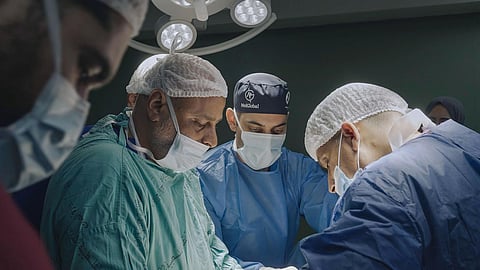
Perlmutter is joined in the medical mission to Gaza by Palestinian-American emergency medicine physician Thaer Ahmad and Zoroastrian Pakistani-American trauma surgeon Feroze Sidhwa. The trio volunteers because they consider providing the aid as a professional, moral, and human duty. It turns them into soldiers of sorts as well, right from how they negotiate the travel to Gaza via Jordan to the fight against the dire situation, working in the midst of attacks, trying to save lives while putting their own lives at risk.
The cameras of Chris Renteria, Ibrahim Al-Otla (directors of photography), Ramzy Haddad, Arthur Nazaryan, and Poh Si Teng herself (cinematographers) follow the doctors in hospitals, paediatric wards, and innumerable surgeries in Gaza, as well as their families and homes, and advocacy and campaigns in America. It captures their interactions with each other and with the Palestinian medics and patients.
While being a verité non-fiction, American Doctor also unwittingly comes to sport a classic narrative. There is drama, but the kind that is horribly close to life. There are edge-of-the-seat moments that unsettle more than thrill, making the blood run cold rather than an adrenaline rush. No wonder all three agree that they haven’t seen anything close to the level of death and destruction in Gaza. Their testimonies are strong proof of the appalling war crimes committed in deliberately targeting kids, civilians, medical practitioners, and hospitals.
Much as the film deals with urgent humanitarian issues, it is also remarkably character-driven. Each of the three doctors receives individualised attention despite their common pursuit and activism. They don’t just come from different backgrounds, but they also have distinct personalities. Each of them has a character arc that grows through the film. Ahmad is deeply committed and driven, a caring family man and parent, who is conflicted about his hyphenated identity (cognitive dissonance as he calls it) in the light of what is happening in his original home. Perlmutter may be the defiant one who doesn’t mince words but is also deeply emotional at heart. Sidhwa is practical, charming, single and eligible, and camera-friendly.
The film is a difficult but mandatory watch. With its focus on the loss of civilian lives and infrastructure, it feels especially urgent and strikes a major chord in the light of the brand new war unfolding these days. However, it also shows a way out of the insanity with the possibility of hope and healing through courage, conscience, humanitarian hearts, and collective commitment to the greater good.
