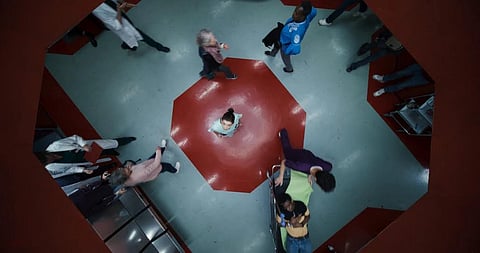

Marion Corroller’s Sanguine (English title Species) has red written all over it. Not only is it bookended by scenes of a heavy flow of sanguine fluid but almost every other frame oozes blood making its French title sound far more apt and expressive than the English name.
The opening sequence sets the tone with a rhapsodical carnage in a fast food joint called Bloody Burger. The young cashier, the employee of the month, month after month, has a practiced smile pasted on his otherwise impassive face. He runs out of patience with a demanding diva of a social media influencer and suddenly changes colours to bludgeon the customer to pulp before bringing himself to a gory end as well.
Such a unique combination of the gruesome and the comedic, the extreme violence and the killing sprees are likely to get the attention and approval of the far-from-squeamish fans of genre cinema but it’s the subtext, though extremely pertinent for the times we are in, that lacks enough meat and could have done with a slightly better fleshed out screenplay, credited to Le Corroller herself along with Thomas Pujol.
2026 will go down in the history of world cinema as the year of successful independent horror films made by popular YouTube creators—Curry Barker’s Obsession and Kane Parsons’s Backrooms to name two. Once dismissed as low budget and inferior, the rise and rise of genre cinema has been a steady phenomenon of late, getting patronised, validated and celebrated not just by the box office but the haughty and exclusive international film festivals as well.
A sideward element to the trend has been female filmmakers taking to horror as a tool to raise gender issues and social concerns. Julia Ducournau (Titane), Jennifer Kent (The Babadook) and Coralie Fargeat (The Substance) have channelled it to focus on the unique physical, mental, familial, social challenges of womanhood. Now Le Corroller joins the growing group with her first feature, the French body horror film that premiered in the Midnight Screenings section of the Cannes Film Festival.
At the centre of it are two women—Margot (Mara Taquin), a young intern at a hospital ER, and her tough as nails and difficult to please, ogre of a department head, Professor Virgile (Karin Viard). Initially enthusiastic about being a doctor, with the trauma of losing her mother to medical negligence as the driving force, Margot is soon confronted with the daily struggles, stresses, gruelling schedules, competitive colleagues and a toxic work environment. Her body starts showing peculiar, scary changes that she can’t control and cure. Over time she realises that she is not the only one, it’s an epidemic catching many young people off guard, including the Bloody Burger cashier and a pregnant insomnia patient of hers, sporting strange rashes on her back.
If it’s a French film, then deviant relationships are not just regular but obligatory. So, you have a subplot with Margot forming a love triangle with fellow interns Louis (Sami Outalbali) and Pauline (Kim Higelin). Needless to say it adds nothing to the film, not even the necessary shock value.
The body horror in Species is all about the work-life imbalance and the burn out it results in, about the pressure for productivity and chase for success wreaking havoc on the young. The enervation leading on to a total collapse with individuals mutating into creatures from another world.
It's a theme that is universally resonant and Le Corroller grounds it in the life of Gen Z. Entirely antithetical to Infosys co-founder Narayana Murthy’s controversial statement advocating 70 to 72-hour workweek for Indian youth and professionals but similar to actress Deepika Padukone’s demand for eight-hour daily work shift that eventually had her walk out of Sandeep Reddy Vanga's upcoming Spirit and the sequel to Kalki 2898 AD.
What Le Corroller lacks in writing, she makes up with confident direction, drawing out wonderfully horrific performances from Taquin and Viard. The visual effects by Pierre-Oliver Persin (previously celebrated for his work in The Substance), especially the body mutation scenes, are outstandingly realised. The use of space—like Margot’s windowless room—by production designer Anne-Sophie Delseries stands out in evoking the sense of suffocation with the music by Rob adding to the doom and gloom.
Species is adequately pulpy and makes for a satisfying sinister watch but could have risen a notch or two by plumbing the depths of the dreadful.
