
Man-woman relationships form the core of several stories told on screen. In Haitian writer-director-actor Gessica Généus’s Marie Madeleine (Mary Magdalene) it becomes an uncommon meeting ground as well as a flashpoint for love, friendship, desire, faith and freedom. The Haiti-France-Belgium-Luxembourg-Canada co-production had its world premiere in the Cannes Premiere section of the recently concluded Cannes Film Festival.
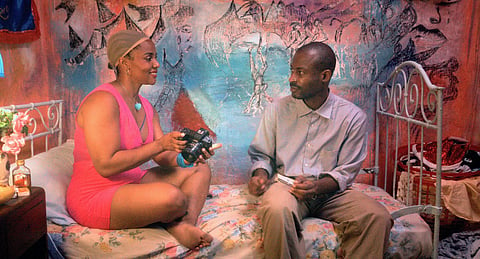
It may not quite be the case of sparks flying but things do get upended and chaotic when Joseph (Béonard Monteau), a man of God in the making, meets a hardened sex worker Marie Madeleine (Généus herself) in the most unusual of circumstances, involving blood, a miscarriage and a hospital.
No two souls could be more unlike each other. One doesn’t just believe in God but also in evangelising and saving the souls of his fellow human beings. The other knows no rules and is the personification of recklessness. As spirituality locks horns with hedonism, a beautiful but tenuous and enigmatic bond starts getting cemented between the two. Will Joseph give in to his buried lust for life or will Marie turn religious? Is it love that the two share or something deeper and defining?
The Biblical reference to Mary Magdalene, the closest follower of Jesus Christ, takes the relationship beyond the carnal, rich as it is with the element of sheltering, nurture and care. If Joseph treats Marie as someone more than a piece of flesh, she encourages his passion for photography and helps him come to terms with his true self, forbidden as his desires might be. It’s all about camaraderie and solidarity in their struggles.
Set in Jacmel, the film makes Haiti’s southern coastal town into a character in its own right. The sea, the churches, the brothels, the queer parades, religious rallies and carnivals, the street and truck art and the characteristic palette of bright shades get captured with vitality and vividness by cinematographer Nicolas Canniccioni with Nathania Pericles’s production design bringing authenticity and character to the place. Marie Madeleine immerses the viewer into the everyday sights and sounds of Haiti and also makes us come face to face with its political, economic and social realities, its dysfunctional and corrupt bureaucracy and police, its beliefs and superstitions.
Sensuous and tactile, the film pushes the envelope when it comes to the visuals and image-making. For instance, the sense of place in the film pivots on the church and the brothel, interestingly placed right across each other. Only here it’s the cloistered church that traps, limits and intimidates, while the open brothel is all about homecoming that is welcoming and healing.
Not just the story and direction, Généus also brings a great sense of empathy to the film with her candid and flamboyant interpretation of the titular character. You don’t just admire Madeleine for her strength and resolve but also feel for her predicaments and vulnerabilities and fall for her easy charm. Monteau is as effortlessly convincing in his repressions, the many interiorities and inhibitions.
The two characters (like the church-brothel divide) also help frame the film from conflicting points of view—the sacred and the profane, the righteous and the amoral, the upright and the sinful. However, Généus uses the polarising device in both the cases to turn things upside down, imbuing the disreputable with compassion and high-mindedness with cruelty. How far can religion be allowed to intrude in and determine our identity, sexual orientation and personal relationships?
The finale plays out as a needless tearjerker and eventually lessens the impact than leave with a high. However, in the queerest ever Cannes, Généus’s critique of otherising, fanaticism, bigotry and intolerance is aptly loud and clear and universally resonant. It is also poised and elegant in its implicit call for harmony and peaceful co-existence.
