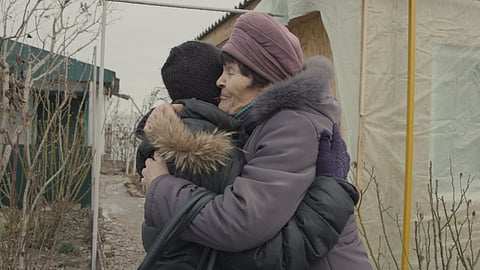

Hillary Clinton had once called women “the primary victims of war”. Alisa Kovalenko’s feature documentary Traces (co-directed with Marysia Nikituik) looks at her assertion from an entirely opposite, empowering lens, spotlighting those who faced indescribable atrocities, survived and decided to tell their harrowing tales. As the film asserts “to survive is to win” and so they are winners in their own right. In this case it’s a group of Ukrainian women who survived CRSV (conflict-related sexual violence) in the Russian war, united under the NGO, SEMA Ukraine, refused to be cowed down by it and didn’t give in to stigma and the accompanying silence.
At the centre is Iryna Dovhan, who had herself been held captive during the war. The narration of the tortures she was subjected to opens and sets up the film and it develops and progresses with her documentation of the testimonies of other women like her, affected by war crimes—Tetiana Vasylenko, Liudmyla Mefodiivna Mymrykova, Galyna Tyshchenko, Olha Cherniak and Nina—now trying to start life anew in the de-occupied Ukrainian territories.
It's no surprise that the Poland-Ukraine co-production won the Panorama Audience Award in the recently concluded Berlinale. It’s impossible to remain untouched by the testimonies unspooling on the screen—in the raw, unvarnished. The vivid dreams of the happiness of the past, whose memory hurts them in the present. The physical abuse, mental wounds and PTSD. How their bodies felt like shells filled with ice and how fear felt like a cold slab of ice.
All of the stories are extremely tough to even bear witness to, what to talk of those who were made to go through these ordeals. There are times when you can’t help not hit the pause button, just to assimilate and process the extent of the horror. Like senior women talking of sexual assaults by soldiers old enough to be their sons or grandsons. Of rape becoming a weapon of mass destruction deployed by a nation, as though toxic masculinity itself wasn’t enough.
How to frame the survivors in such searing cinema has always been up for debate. To reveal their identity or to keep it concealed. How not to overstep their personal space. How to let them have control of what they want to share and what they want to conceal. It helps that Kovalenko, having lived through the experience herself, hasn’t just directed but also shot the film. Her camera follows the ladies, frames them with respect and dignity, aligns and becomes one with them, empathetic not intrusive, as their voice overs fill in the details.
The care and compassion reflect in the deliberate, tentative pace of the film achieved through the measured editing by Nikon Romanchenko, Milenia Fiedler and Kovalenko and the gentle, almost unobtrusive original score by Wojciech Frycz. Here’s a film that is not in a rush to go anywhere but stay with its protagonists, not push anything down the viewers’ throat but to make them witness a harsh reality, not to pander to sentimentality but to appeal to their essential humanity.
“Nerves of steel were wired to a soft heart,” is a phrase often quoted from the book The War on Women by British journalist Sue Lloyd-Roberts. Despite the violence and turmoil of their lives the warrior women in Traces have an admirable and inspiring sense of centredness, care, courage, commitment and compassion.
Their collectivism is like a metaphor for the rightful and righteous resistance and fight for truth and justice. It promises healing and a future of hope, away from the pains of the past. Ever so often, while watching the film, I kept going back to Maya Angelou’s famous poem, Still I Rise: “Leaving behind nights of terror and fear, I rise; Into a daybreak that’s wondrously clear, I rise”. Traces honours a defiant solidarity and sisterhood that believes that “to march on is to fight back”.