
Cinema Without Borders:
Caught as we are in the thick of an AQI crisis, the deluge of dust and epidemic of respiratory disease in Ratchapoom Boonbunchachoke’s A Useful Ghost strikes an eminently relatable note. Not to forget the mention of “the government taking pollution seriously”. But before you can even wonder if it as an environmental film or a cautionary tale about the dire consequences of unbridled developmental activity—breaking down artistic murals and old shophouses making way for modern malls—it reveals itself as one of the most enticing, enigmatic and thought-provoking films of the year.
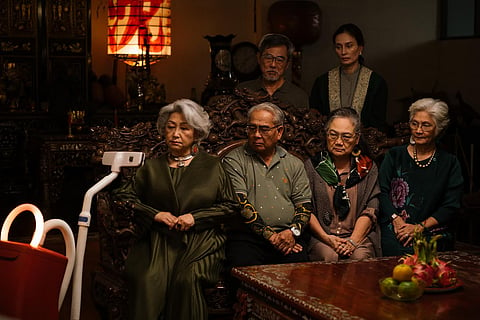
Overwhelmed by the dust at home and in the city, an “academic ladyboy”, as he describes himself, (Wisarut Homhuan) orders a vacuum cleaner. In the night he hears it coughing and spewing out the very dirt it had cleaned in the day. Krong (Wanlop Rungkumjad), the technician sent by the service centre, divulges a stupefying piece of information—that the machine is possessed by a ghost. In the story within the story format, Krong tells the ladyboy and, in turn, the audience, all about the haunted factory where the appliance was manufactured and the travails of the family that owns it.
The man-machine love and war and the family’s domestic issues keep taking fresh twists and turns, as new ghosts—from the romantic to the angry kinds—appear and disappear.
In the beginning Boonbunchachoke storytelling has a languid flow interjected with shots of black humour. The otherworldly game of love, desire and seduction is as moving as it is mirthful. Remembrance is the key. Ghosts stay around so long as we hold on to memories of the people that they were. They get cast away if we forget them or if they no longer remain what the same person that they once used to be.
The performances are perfectly in sync. The technical aspects are as much in tandem. Pasit Tandaechanurat’s camera, Chonlasit Upanigkit’s editing and Chaibovon Seelukwa’s music are beautifully synchronous to lend a rhythmic edge to Boonbunchachoke’s filmmaking.
But all of this cinematic harmony builds towards a chaotic, mayhem of an end with heavy, intense music to boot. A Useful Ghost stands out in the way Boonbunchachoke marks a gradual transition from the poetic and romantic to the larger grim, contentious issues confronting his nation and its history. Deep inside the supernatural family dramedy beats a political heart.
On the one hand, there are the class wars housed right in the factory itself: the heartlessness, opportunism and materialism of the bourgeoisie as opposed to the silent workforce that is forced into a rebellion against its employer.
On the other is the history of political violence, the inconvenient ghosts who are reminders of the atrocities of the past. “The ghosts of Viet Cong can’t leave me alone,” says an insomniac minister, who wants the surveillance of the dreams of the current lot of protestors to obliterate any thoughts in their minds of the preceding events. Should one erase those brutalities for personal gain? Would a mass exorcism of the ghosts absolve the guilty of their political crimes and sins? Can there be atonement without penance? Should the dead then not mess with the living? Though urban in its setting, A Useful Ghost reminded me of some of author Vijaydan Detha’s works in which the folklore and fantasy come with a profound allegorical, moral core attached.
The Thailand-France-Singapore-Germany co-production premiered in the parallel Critics’ Week segment in Cannes bagging its top prize. It was Thailand’s entry for the Best International Feature Film Oscar but does not figure in the final list of films sent to Academy voters. Closer home, it was screened at the International Film Festival of Kerala this Sunday.
