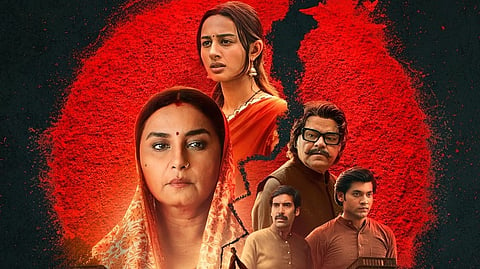

I tuned in for Chiraiya with a sense of skepticism. After all, how much novelty can one bring to a subject like this, where it’s rather easy to pick sides, where one has a clear sense of right and wrong before we hear a story? Chiraiya impresses in how it unfolds, and who it chooses as the protagonist. Kamlesh (played by an excellent Divya Dutta), despite being surrounded by largely supportive and “progressive” in-laws, is a conservative woman. A classic case of someone who has deeply internalised misogyny. She is as much a victim of patriarchy as much the perpetrator.
Cast: Divya Dutta, Prasanna Bisht, Siddharth Shaw, Faisal Rashid, Sanjay Mishra
Director: Shashant Shah
Created by: Divy Nidhi Sharma
Streaming on: Jio Hotstar
Rating: 3 stars
The show jumps straight into action, and takes little time to arrive at the central conflict. Arun (Siddharth Shaw) and Pooja (Prasanna Bisht) get married in a conventional arranged marriage set-up. Both come from middle-class families but are poles apart in their value system. Arun, who has so far appeared like a harmless little man, decides to unleash his beastly self on the first night of their marriage. He rapes Pooja multiple times. Arun’s sister-in-law, Kamlesh, who has so far been sceptical about Pooja as a worthy addition to the family, slowly becomes an empathetic ally for her as the latter battles her way out of her new life as a silent, obedient 'bahu'.
When it comes to stories driven by a message, films and shows often commit the folly of preaching to the converted. In a clever subversion, Chiraiya starts from a place of emotional distance. It’s a story of Kamlesh’s journey instead. Every time she learns something for herself, the audience is allowed to partake in her journey. We are not ahead of her, waiting to catch up. This also occasionally appears to be one of the show's weaknesses — In order to give a stage to Kamlesh, the writers sadly end up sidelining Pooja’s journey. Straddling two paths at once would have been a far more complex narrative, no doubt, but also more rewarding as a viewer.
Chiraiya has other bigger problems though. The series suffers from the excess in many ways. Relentless in its sense of sermonising, it doesn’t know where to pull the breaks. Every scene is underlined with a statement, and every statement is underlined with heavy-handed treatment just so that we don’t miss out on the theme. The show has no trust in its viewers. While there are a few good men in the series, the show is not afraid of pointing fingers at the root problems of our society, and how it’s still governed by patriarchy. But after a point, with so much finger-wagging, it must physically hurt. The narrative has no patience for nuance or subtlety, operating with the aesthetics of a TV soap opera. Arun (Siddharth Shaw) is an outright antagonist, irredeemable in every which way. The background score is loud, and the slo-mo charging shots, for even of the most mundane proceedings, are way too many. The show also goes overboard when it introduces Kamlesh’s grandfather (Tinnu Anand), whose empathy makes the puzzle much harder — why did Kamlesh become the woman that she was?
The show also gets so involved with its statement that it forgets to aptly flesh out some of its key characters and their dynamics with each other — which is why some moments with Kamlesh and her husband feel unearned. With so many characters who carry a lot of complexities, the show could have benefitted from a narrative that breathes a little before it fires shots. And yet, the series remains impactful in its messaging, despite such an in-your-face execution.
Chiraiya is not devoid of interesting storytelling choices, though. At one point, the sound of door-banging hauntingly merges into the background score. A scene in episode 2 subtly builds the contrast between the rashes on Kamlesh and Pooja’s necks. Amidst its heavy-handed treatment, there are also a few genuinely thought-provoking conversations, like the one where Kamlesh’s husband (An earnest Faisal Rashid) talks about the easy choice of looking away, or when Kamlesh wonders why there is no word to describe a mother’s hesitance before giving ‘the talk’ to her daughter. The show also addresses the much-debated subject of how the battle between men and women can never be equal in the first place. In another clever device, we hear Kamlesh’s thoughts that stand in stark opposition with the events she is part of, almost giving a comedic touch to the narrative. But in these moments, Chiraiya also captures how most people, while often living together, operate in two different emotional worlds altogether. Prasanna Bisht, playing Pooja, delivers a brilliant performance, capturing that sense of isolation and claustrophobia one must feel in her place.
Meanwhile, despite some simplistic broad strokes, Kamlesh remains a character worth rooting for. Underneath her conservatism, she carries a lot of guilt and a sense of void. Nobody overtly blamed her, but she regrets not giving a boy child to her family. Kamlesh also feels responsible for how Arun has turned out to be — in his virtues also lies her self-worth. She does not emerge as a flag-bearer out of nowhere — it’s a complex wayward journey that comes partly out of empathy, and partly out of seeking redemption. Even when she is out to get justice, Kamlesh has her moments of weakness and vulnerability which fail her — and she is reminded of her weakness by someone who previously empowered her the most, her father-in-law.
After Vadh 2, Sanjay Mishra finds another role that gives him space to explore the grey. And it’s a great fit for him, essaying a seemingly gentle old man who remains an oppressive figure underneath it all. A big blockbuster, which released around two years ago, warned us to be mindful of poets who can be seductive with their words. That film’s critics warned us to be mindful of alpha males who remain dismissive of poetry. Among other things, Chiraiya tells us to be cautious of those animals who thrive in broad society under the endearing allure of poetry.
