
Main Vaapas Aaunga Movie Review
“There behind barbed wire, on one side, lay India and behind more barbed wire, on the other side, lay Pakistan. In between, on a bit of earth which had no name, lay Toba Tek Singh.” Manto’s short story and its essence hit me like a truck while experiencing Imtiaz Ali’s poetic, Partition-era romantic-drama Main Vaapas Aaunga. Just like Toba Tek Singh, now lies Ishar Singh Grewal (Naseeruddin Shah) on his deathbed. His soul too seems stuck in the barbed wire between India and Pakistan. It can’t depart. He is grabbing on to see his pre-Partition city of Sargodha for one last time, to see Jiya/ Afsana for one last time. This girl of his youth smiles in his blurred dreams and says, “See, no. My chaand bali (earring) has fallen off somewhere. Will you find it for me?”
Directed by: Imtiaz Ali
Written by: Imtiaz Ali and Nayanika Mahtan
Starring: Naseeruddin Shah, Diljit Dosanjh, Sharvari, Vedang Raina, Rajat Kapoor and Banita Sandhu
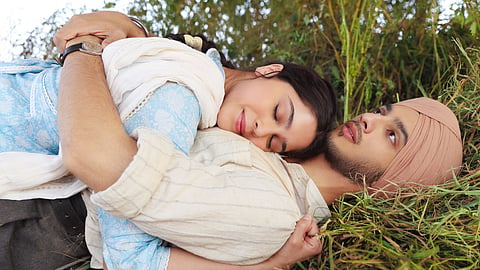
Ishar, now old and stiff, was once young and carefree Keenu (Vedang Raina). He lived and loved in United India’s Sargodha. His love and longing was Afsana (Sharvari) who has now become a tale he can’t forget. His grandson Nirvair (Diljit Dosanjh) has flown in from London to see him for the last time but Ishar only sees his childhood friend’s baby face in Nirvair’s. His friend who was left behind in Sargodha and not just him, his love, his youth, his innocence, his mother and his sisters all were left behind. He spent all his life turned into a rock which can’t be turned back. But now age has softened him into a pebble which wants to flow back home. Like in Love Aaj Kal (2009), Deepika Padukone asks Rishi Kapoor, “Why is it always like this? Even after so many goodbyes, why is it important to meet for one last time?”
Ishar wants to go back and Nirvair wants to run away. He lives in London and in a year has quit his third 9 to 5 job. He can’t commit to the girl he is seeing. He has fledgling dreams of becoming a comedian but currently is the punchline at each standup trial. This feeling of displacement is his inheritance. Running away runs in his genes. But his ancestors were running away from India and Pakistan, who is he fleeing from? Himself?
Nirvair is an Imtiaz man, curious, confused and conflicted. He hides behind bad jokes and avoids confrontations. He has pieces of Rockstar’s (2011) Janardhan in him, his innocence mirrors Abhay Deol’s Viren’s from Socha Na Tha (2005). Diljit plays him with such finesse. He is funny but not a comic relief, emotional but never breaking down. Nirvair is like a blank slate on whom a new history is being written. A new generation which can finally jettison the pain.
But what about the girl? The Jiya/Afsana/ Mallika Dilfareb who keeps popping up in Ishar’s last memories? Sharvari plays her like a dream, with a goofy charm which is both mesmerizing and magnetic. Afsana is an Imtiaz Ali heroine, speeding away on a bicycle, laughing, as Vedang’s Keenu tries to catch up. The latter too fits beautifully in the film as he plays a nervous youngling trying to find his feet.
Imtiaz perfectly weaves a soul-stirring story of pain, pining and Partition and presents it via a cracking prism of a love story. Cinematographer Sylvester Fonseca’s lens sees Punjab in a washed away sunlight as if it is waiting for the mist of misery, the black smoke of separation to take over. AR Rahman’s music is adorned by Irshad Kamil’s lyrics which on one side give speech to a girl’s urge to beautify herself for her first love (‘Maskara’) and on the other convey the turmoil of a refugee (‘Vo Nahin’). Editor Aarti Bajaj has stitched the film together like an elegant embroidery, which evokes the feeling of being somewhere between a memory and a dream.
Imtiaz has never been a particularly political filmmaker, atleast not directly. His films always come from a deep, personal place. His characters almost always are the misfits who want to run away to find themselves. This time he zooms out, he makes the personal, political. Main Vaapas Aaunga is about Punjab, about the buried trauma of the refugees and how pain gives birth to patriarchy. It is about a past which asks a question to our present: “Have we not learnt anything?” But cut all of that, let the politics be only in a politician’s speech and this film is about a boy who was sadly made into a man by Partition and now old age has turned him back into a child. It is a story of moving on but then going back. Of Toba Tek Singh and Ishar Singh. Of his longing. Lying on the border, Toba Tek Singh has finally shut his eyes and Ishar Singh is finally meeting Jiya, Afsana, his Mallika Dilfareb in a green field which is beyond India and Pakistan, beyond right and wrong.
