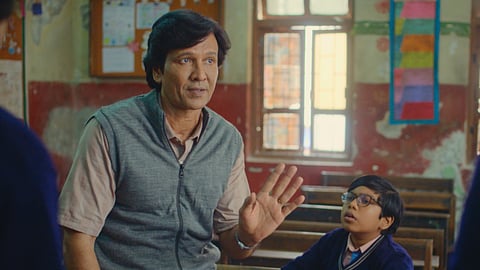

Adarsh Baal Vidyalaya Review:
Why should one go to school? If you ask the students of Adarsh Baal Vidyalaya, they might answer: to play cricket with their headmaster, or to enjoy kheer in the midday meal. For girl students, it means a 5k deposit in their parents’ bank accounts, a government incentive for women empowerment (the money is then used by parents to pay for the girl’s dowry). But then one of the female students states she doesn’t want to study anymore. She would rather marry her hip-hop dancer boyfriend. When a teacher tries to convince the girl, she declares: It’s my choice. It’s an amusing conundrum. What is actually the real purpose of education? It’s a question that the Prime Video series Adarsh Baal Vidyalaya, from the house of Posham Pa Pictures (Kaala Paani, Maamla Legal Hai), keeps circling back to. Is it for these kids--most of them who come from marginalised backgrounds--to make money and pull their families out of poverty? Because that they can do by network marketing or working at a local tobacco factory. What can really a school provide them? When the boyfriend doesn’t come to pick her up, the above-mentioned girl takes up a cycle and rides on her own. She doesn’t have to wait for anybody anymore. Education gives independence.
Creators: Sameer Saxena and Biswapati Sarkar
Director: Himank Gaur
Written by: Akshay Asthana, Tatsat Pandey, Nupur Pai, and Biswapati Sarkar
Cast: Kay Kay Menon, Archana Puran Singh, Deven Bhojani, Abhimanyu Singh, Naveen Kasturia, and Prasanna Bisht
Streamer: Prime Video
But can Adarsh Baal Vidyalaya (ABV) shape future model citizens of the country? The ramshackle government school, situated “left from the gutter” in the fictional area of Tinki Toli in New Delhi, has nothing going for it. The English teacher claims he has ‘sydlexia’ (read: dyslexia), the chemistry lab is used to make tea, and the students think the three states of matter are UP, Bihar and Haryana (“those are the states that really matter”). But when headmaster Gyaneshwar (Kay Kay Menon) stumbles upon the opportunity to go to United Kingdom to attend training at Cambridge University, he and his arsenal of teachers have to do everything to get ABV in the top 10 schools in the city with the best board results.
Writers Akshay Asthana, Tatsat Pandey, Nupur Pai, and Biswapati Sarkar fill the show with interesting, endearing characters. A chill headmaster at school, Kay Kay’s Gyaneshwar is a struggling middle-class man at home who constantly feels inadequate to his wife; newly-appointed idealistic Math teacher Kanchan (Prasanna Bisht) is finding it difficult to discipline children without corporal punishment; during the day, macho Hindi adhyapak Hansraj Meena (Abhimanyu Singh) busies his hands with hitting children but at night the same hands put henna in weddings; the school counsellor Mukul (Naveer Kasturia) is unable to form a bond with his daughter; and biology teacher Sharma ma’am (Annapurna Soni) clutches her pallu to her mouth at the mention of intercourse. During the seven-episode run of the series, each character faces an impossible choice, which they make in heartwarming and humorous ways.
Although delivered conversationally, the jokes are relentless. Hence, oftentimes there runs a risk of diluting the issues the show is shedding light on. Although when the satire hits, it’s always bull’s eye. The government school becomes the microcosm of our country. The kheer that is removed from the midday meal could very well have been eggs, a volcanic reporter asks difficult questions to young students to make them sound stupid on camera, and a local politician wants his family’s history to be taught in schools.
Adarsh Baal Vidyalaya often seems to play out like a satirical play overdone with theatrics (the second-screen-viewer-friendly, happenings-announcing BGM is a pet peeve) and although some punchlines are unnecessarily underlined, the series scores on emotions. The relationship between math teacher Kanchan and the strict Meena sir is adorable; Kay Kay Menon Gyaneshwar’s track is heartwarming. The actor too plays the headmaster with this subtle sweetness. Students, teachers, parents, viewers, everybody learns a thing or two in the course of this series. In a frame, Meena sir sits in a classroom and the blackboard behind him reads: “Ahinsa taakatwar ka hathiyar hain” (Non-violence is the weapon of the powerful). A timely lesson for those in power in our country.
