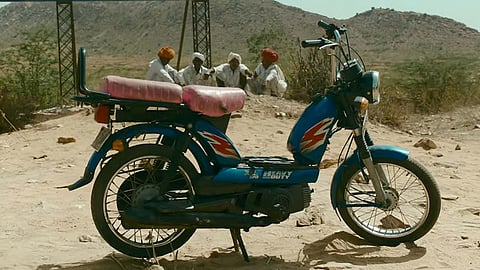


Director Ritwik Pareek’s Dug Dug is a film with a fascinating premise that deals with the commercialisation of religion in India in a quirky way. It shows the gradual formation of a religious cult from a small idea that becomes something mythical through word of mouth. The film starts with the visual of an alcoholic man named Thakur (Altaf Khan) who encounters a brutal accident after riding a motorbike in an inebriated state. The following morning, the impounded motorcycle mysteriously disappears from the police station and resurfaces at the same accident spot. Has someone taken it there? Or does it have the spirit of Thakur? The bizarre incident forces nearby residents to deify Thakur and serve up alcohol to him and the Luna bike as a form of religious offering. One thing leads to another, and Thakur’s story turns into a religious cult overnight.
The premise of Dug Dug, which is out on Prime Video after a limited theatrical run, is undeniably brilliant. Remarkably, it is based on a real story in Rajasthan about the gruesome death of a man in a road accident and the deification of him with his Royal Enfield Bullet bike. Unfortunately, however, director Ritwik Pareek does not bother to tell a human story in Dug Dug. The characters are abstract ideas here, their arcs feel incomplete, and the story suffers from repetition.
Pareek believes in excess, stretching every idea out to the hilt at the expense of storytelling. The repetition means that the premise, which would easily make for a compelling short film, feels like it is bloated into a 100-minute feature film. The film uses too many sequences just to show how the cult behind Thakur’s death becomes a religious phenomenon. It repeats even the metaphoric visual of a man blowing a balloon, to symbolise the exaggeration of a small event into something mythical, over and over again. The treatment of the central metaphor seems like a joke that is funny initially but loses bite when the comedian spends the next hour explaining the punch line.
Director: Ritwik Pareek
Streamer: Prime Video
Cast: Altaf Khan, Gaurav Soni, Yogendra Singh, Durga Lal Saini, Hemant Sharma, Jagdish Prasad Tak, Raju Gujjar, Priyanka Khandekar
That said, this indie film is definitely worth a watch as its ideas are fascinating. The climax is easily the most brilliant aspect of the film because it perfectly captures how cults and myths triumph ultimately. The surrender of a character who is initially skeptical about the existence of Thakur as a God highlights a fundamental truth about human psychology: personal, emotional need often triumphs over hard, cold logic. By choosing the myth, the character prioritises emotional comfort over intellectual integrity. It shows that even those who build or witness the scaffolding of a lie would eventually succumb to it if it gives some meaning and purpose to their lives. The final image of the character holding his child up to the 'motorcycle idol' completes Pareek's punchline: the cycle is complete, and the next generation is being baptised into the delusion not by fake prophets but rather a parent who knows the truth and yet chooses to overlook it.
The opening sequence is also incredibly clever because it sets up the film's thesis on fate, human vulnerability, and the manufacturing of miracles. When Thakur is actively navigating the chaotic main road, he survives despite being incredibly high on alcohol. In a sequence full of tension, he manages to cheat death against all odds. However, the moment he moves to a virtually empty and quiet side road, the real danger shifts from the environment to a psychological one. The presence of a massive billboard advertising a magical event is an irony that drives the narrative. It represents what the film spends the next hour or so dissecting: our blind belief in the supernatural, the divine, and the magical. Thakur does not die because a chaotic, unavoidable accident forces him off the road. He literally falls over under the shadow of a billboard promising magic, only to be crushed by a passing vehicle a moment later. By having him die right beneath that board, the film creates a brilliant cause-and-effect: The piece of advertisement promises magic, Thakur dies beneath it, and the locals use his death to create the same magic that it sells.
This is a deeply dark, comedic way to open a story. It tells the audience right from the first frame that this is not a film about a divine intervention but rather about how humans look at a tragic and entirely mundane event and somehow pull a religion out of it. While Pareek's execution leaves a lot to be desired, it is not without its merits.