
Ikkis Movie Review: Sriram Raghavan’s war-drama is a predictable peace-offering in a polarized country
Ikkis(2 / 5)
During the promotions of his 1998 film Saving Private Ryan, Steven Spielberg famously said, “Every war movie, good or bad, is an anti-war movie.” Francis Truffaut had already given a counter fifteen years before: “There’s no such thing as an anti-war film.” In the context of Hindi cinema, I would go on to say “most war movies are boring war movies.” It’s a dead genre unable to break out of its patterns and the biggest reason for that is because it actively rejects nuance. The soldier at the centre of a Hindi war film can’t seem to have a dimension to his personality that is bigger than the incessant urge to bring glory to his motherland. He is a white character who can’t have gray motivations. There can’t be questions raised on nationalism itself as an idea. As a result, most Indian war films seem like an over two-hour recruitment advertorial by the Ministry of Defence.
Cast: Agastya Nanda, Dharmendra, Jaideep Ahlawat, Sikandar Kher and Simar Bhatia
Directed by: Sriram Raghavan
In a post-Dhurandhar India, where chest-thumping nationalism, ‘ghar mein ghus ke maarna’ (intruding and killing) and baying for Pakistan’s blood is one extreme, Sriram Raghavan’s Ikkis presents another, of Indians and Pakistanis being loving, lost brothers stuck in ‘siasi khel’ (political games). A former Indian Army officer pays a visit to Pakistan to attend his school reunion. His real intention is to go to the place where his son, who died in the battlefield, breathed his last. The officer is being escorted by a hospitable Pakistani general and all of this is happening in the immediate aftermath of the Kargil War. The intent is noble, the events might be true, but it doesn’t feel believable. Ikkis feels like the epitome of the “aman ki aasha” film the right-wing trolls on X believe Bollywood keeps churning out. It is a run-of-the-mill war film transported to the wrong era.
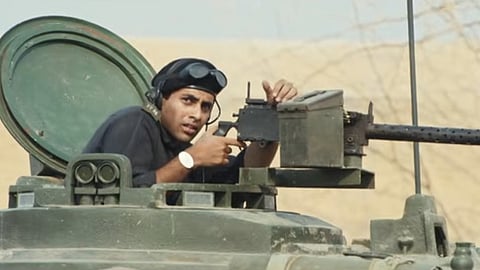
The film goes back-n-forth between two timelines. One is in 1971, where 21-year-old Arun Khetarpal (Agastya Nanda in his theatrical debut) is summoned to the border to man a tank during the India-Pakistan war. The other concerns Arun’s father, retired Brigadier M.L. Khetarpal (Dharmendra in his final role) and his visit to Pakistan to pay his last respects to his martyred son. Khetarpal is staying at the house of Nissar (Jaideep Ahlawat) who is also housing a secret.
Arun’s journey progresses from his days at the National Defense Academy (NDA) where he leads his house to win at a sports tournament. Newbie Agastya plays Arun with sincerity and a boyish charm. He is shown to be a stickler for rules but this aspect of his personality is never sufficiently explored. The war-crazed Arun beams with joy when he is called to the battlefield but we never quite know what makes him so devotional towards duty. Is he merely following the footsteps of his father and his grandfather, both of whom were Army officers before him, or is there something deeper?
I also sensed a budding literary quality in the film. Ikkis often gives you images which belong to a soldier’s letters from the battlefield, like that of a trooper lying dead as a radio emanates tunes of an old Hindi film song. In a Sriram Raghavan-signature Arun is seen reading Ernest Hemingway’s For Whom The Bell Tolls, a book which discusses the cost of war and whose title comes from a John Donne quote which means every human life is connected and that the death of one diminishes the whole.
If all war films are reduced to being merely action films with patriotism, Ikkis falters here too. Tank warfare can get repetitive after a while. The film falls into the predictable pit of a war drama. Drunk soldiers will dance around a fireplace, Arun will look at a photo of his beloved in the dead of the night and a trooper will die mid-sentence. The works.
The film actually works best as a Dharmendra farewell piece. It’s heartwarming to witness the actor, reciting a poem on the pining to see his hometown for one last time, as he rides in a car which passes through green fields of Lahore. A landscape very similar to Dharmendra’s home-state of Punjab. It’s a bittersweet moment when the veteran actor, in a scene, talks about celebrating his birthday next month. Another sequence shows Dharmendra sitting opposite his Sholay (1975) co-actor Asrani, another veteran we lost this year. The latter, in a cameo, plays an old man from Pakistan, suffering from Alzheimer’s. “India and Pakistan are partitioned?” he asks Dharmendra’s Khetarpal in disbelief. This isn’t the world he wished for.