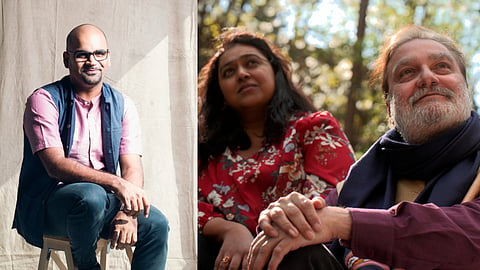


Director Anshul Tiwari's Bayaar follows three friends who move into a lodge on a hill station and confront their worst fears and insecurities as they navigate the prospects of entering a mysterious place, called 'Bayoul'. Starring Vinay Pathak, Shalmalee Vaidya, and Rachita Arke, among others, the film is a reinterpretation of Jean-Paul Sartre's play Huis Clos set against the backdrop of the Himalayas. Featuring strong performances, the film works as a profound meditation on death, grief, and the afterlife. Ahead of its premiere at the UK Asian Film Festival on May 09, Anshul spoke to CE about the themes of Bayaar, the inspirations behind it, his favourite films about the afterlife, Vinay Pathak, and more.
Bayaar is reminiscent of Andrei Tarkovsky’s Stalker, especially the search for a mysterious place by its principal characters...
It’s a really uncanny and perceptive connection to make. It’s uncanny because that was the reference I gave to my composer for the score, and perceptive because Stalker is one of my all-time favorites from Tarkovsky. Perhaps it subconsciously informed my choices while writing the story, as well as while filming it. I learnt that Tarkovsky had to reshoot a lot of the film because the film stock wasn’t properly exposed the first time around. What a disaster! But it also speaks to the conviction he had about the story, which brought him back to reshoot that film.
It is also reminiscent of The Man From Earth, this spiritual film about the existence of mankind from time immemorial
I haven’t seen that one, but what you say already makes me curious about it. I will find it soon.
Your father’s passing inspired the film. It is unimaginable what that must have been like. Was its making cathartic in a way, and does it resemble the sort of catharsis the characters experience?
My father died of heart failure during a family road trip. His doctor had warned him to take it easy—perhaps avoid travel—but we had made plans and he never let on to any of us just how bad it was until it happened on that fateful morning. I watched him go, helplessly. There is only so much you can do in a strange place, far from home, with no medical help nearby. I was filled with the guilt and shame of not being 'adult' enough to save him.
But things took a different turn during the 13 days of mourning. We laughed and joked, remembering all the great times we spent together. As our life together went past my mind’s eye, I wondered: why don’t we love each other more while we are alive? I called my friends and family from near and far, just to tell them I cared for them and thought about them. I knew life would soon take over and this feeling of unconditional love would not remain forever.
Over the years, these feelings crystallised into Bayaar. The original idea of three friends traveling together didn’t come from me; it was Shalmalee Vaidya (Sreemoi) who came up with that setting. Debasmita, the producer, added the gut punch of making all these people dead. After I read Sartre’s Huis Clos (No Exit), things clicked in my head and I relived the experience of my father’s death all over again while writing the screenplay. I had the privilege of time to reach into my imagination and set the narrative in motion. All the poetry that came during this period emerged from the space of healing and peace you experience when you stop fearing death and embrace it.
The film discusses the concept of the afterlife, which in itself is quite alluring. Do you believe in it?
Belief. That’s an interesting word, isn’t it? While I don’t have any memory of past afterlives, I have had dreams of being in a different place, being a different person—and who is to say they are not real? Dreams are strange and magical things we experience in life. Our ancient masters have talked about the afterlife in scriptures and old texts, like the Tibetan Book of the Dead, which is a fabulously detailed account of the different stages of death and the afterlife. The Bhagavad Gita talks about it. The Egyptians talked about it. Several near-death experiences have been recorded. There is a TED talk which illustrates case studies of people awash in peace shortly after they die. This is a subject people don’t talk about much since we have lost connection to this ancient knowledge due to the drudgery of modern life.
Which are your favourite films that explore the afterlife?
I draw my inspiration from documentaries and books more than the films themselves. I have watched endless hours of documentaries on this subject—interviews and real-life accounts captured for medical research. Many near-death experiences have mentioned a helper, an usher, a divine friend, and a journey into light. There was a BBC podcast about patients who were comatose for several hours before coming back to life. One patient described going underwater then emerging; another was in a waiting room. The Booker Prize-winning The Seven Moons of Maali Almeida by Shehan Karunatilaka is set in the afterlife of a photojournalist. And, of course, there is Sartre’s Huis Clos (No Exit), which was the original inspiration.
The films that left a deep impression were Bergman’s The Seventh Seal and Wild Strawberries, and Kore-eda’s After Life, which features clerks who work with the recently deceased to help them heal through the power of a single memory. If I were allowed to go on a slight tangent, Kurosawa’s Dreams has also been a great influence.
Your previous film also explores death, grief, and the afterlife. Why has death become such a recurring theme in your filmography?
Death is a certainty we all face. As the English proverb goes, “In the midst of life, we are in death.” Death is infinitely fascinating. It holds the key to the mysteries of life. I am much more drawn to the spiritual than the corporeal - both in cinema and in life. I am always on the lookout for stories, angles, visual metaphors, paintings and photographs that capture this aspect of our existence, hence it is only natural that it seeps into my work. I am not a morbid person. This notion comes from a desire to realise and capture the uncoloured truth in a story, so it goes out without the tyranny of doctrines or preachers. There is also the attempt to make this subject more accessible, with simple narrative storylines and characters akin to our real world encounters.
The actors perform with such conviction, like they believe in what they say. What's the key to getting them into that zone of mind?
There is no magic bullet to preparing the actors. It’s a series of small choices leading up to a grand showcase. Casting began before I started the project. I knew of Shalmalee Vaidya (Sreemoi), and Rachita Arke (Sam) from Singapore’s theatre circuit. They are both formidable actors on stage who have honed their craft over many years. They share great chemistry as longtime friends. Shalmalee had worked with me in Before Life After Death and we wanted to work together again, so we started Bayaar.
After I wrote the first draft of the screenplay with the co-writer, and producer Debasmita Dasgupta, we started our acting workshops to hash out scenes. It was a space to dream, to play, to experiment, make mistakes where the actors discovered their characters by action and dialogue. Then, COVID hit and our production was delayed by almost a year. So we had all the time in the world to run these acting workshops. Before we went to shoot, both Shalmalee and Rachita had abundantly experienced their screenplay counterparts as living and breathing persons. We had our workshop playbook ready that I repeated with the rest of the cast on a compressed timescale.
It's commendable how you toy with the audience’s perception of Vinay Pathak’s character. There is a mystery around him. Also, he isn't usually known for such brooding gravitas; people associate him with comedies like Bheja Fry...
Vinay Pathak is an endlessly inventive thespian, which informs a lot of his acting choices on both stage and film. His command over language and body is breathtaking. He is also very perceptive about the script and any inner flaws that might creep up later. His character had no 'arc,' so to speak, so there was no room for traditional development. Yet, to give the story an engine, it had to build up and be engaging.
My original direction for Vinay was to use his comedic persona—making fun and cracking jokes like Zorba the Greek. But over a series of workshops, we decided to hold back on the jests and let more compassionate, loving, and sincere aspects of his character, Ved Prakash, emerge. He is the kind of person who shows kindness when no one is watching. The camera loved Vinay’s brooding persona, and it was a real discovery to see him in this new avatar.
'Bayoul' being inside one's mind is such a beautiful idea. It's reminiscent of Paulo Coelho's The Alchemist. The ultimate quest, only to find that it's been with you all along...
This was a decisive moment in the story when one realises that 'Bayoul' is within you, not outside. The world is what you make of it. You are ready to experience divine when you know you are ready. I heard a great master say, “Only fools ask the divine to manifest itself. The enlightened ones experience it within.” This is the idea of Darshan - the direct experience of the Truth.
What are your release plans for Bayaar?
Bayaar is on its festival journey for the larger part of 2026. We are in talks with a few streamers for a release plan in 2027. Regarding future work, I have just finished my third feature film for Netflix—a World War II action-drama titled The Ghost and the Gun. It’s a complete diversion from my earlier two films as it is set in British Malaya and is in Bahasa and English. The film is slated to come out in 2026. I have two more projects in development: an adaptation of Hamlet set in Southeast Asia and a cross-cultural narrative set in modern-day London.