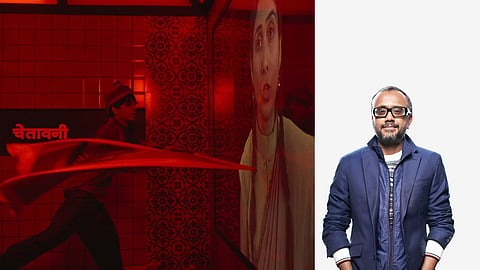

While one might not think of masala cinema and filmmaker Dibakar Banerjee in the same sentence, his film, Tees, is a unique masala film. Switching through different timelines, the film jumps back and forth between a dramatic story in 1989, which happens right before the Kashmiri insurgency, a romantic drama centred on an interracial homosexual couple in 2019, and a dystopian techno-centric film set in 2042. Starring Manisha Koirala, Huma Qureshi, Shashank Arora, Kalki Koechlin, and Naseeruddin Shah, the film was made for streaming, but was shelved after completion of production. In this conversation with CE, Dibakar talks about the various aspects of Tees, and his perspective of art and dystopia.
Excerpts:
How did Tees even begin? What prompted you to go down this road?
There isn’t one specific inspiration for making the film. During 2019 or ’20, I wanted to tell a story for people to watch along with their family. Specifically, the post-modern family of the 2020 era. This particular story about the quintessential universal Indian family, is something that connects Indians across the board like no other. We have a deep connection between our consciousness and the society, in a personal lens. Yet, everybody comes together socially and has an effect on each other across generations.
Something that is on the rise now is creators practising self-censorship. Did you have to grapple with it?
I agree with you, and this is what it is. But a more fruitful discussion would be asking questions like why is art present in society? And why do we do art? These are questions to be asked by artists themselves, not anyone else. We also have to debate on what art does for us? Why do we feel compelled to do it under all circumstances against all odds? What defines us as humans? Once you start asking all these questions, I think that is a better way of squaring up and facing these times.
What does art mean to you? How does it define you?
My current definition of art is that it is a social ritual that holds up many ideals. Social rituals, which in my opinion, reflects through personal outpouring. Art at its best always picks up themes of oneness and empathy. So, when you paint lots of bulls on a cave, you can tell that he is amazed at the sight of them, even though he is hunting them. He is talking about it and mythologising it, by way of describing them as magic.
While this is one kind of art, the other kind of art talks about ideals which are tools that take you to another place. These ideals are also a gateway to figuring out why we are humans and what our purpose is. So art always takes us in an empathetic direction, which repeatedly reinforces our sense of oneness.
Tees delves into various real-life incidents... Whenever they are spoken about in the film, they are conversational and mostly recalled from memory, instead of being showcased visually... Why?
If you want to tell an intergenerational story, then you have to use the language of memory. Take away a lot of things from yourself, what remains is the memory only. Memory is the lens through which we view our past. So if you take that out you take humanity out.
Was the storyline of the cookbook and its eventual censorship struggles in the dystopian storyline, a way to challenge the definition of dystopia?
I think we fetishise dystopia. I think we live with the delusion that a dystopia will happen in an imaginary future. Somehow by the law of storytelling, we think that we are safe from that dystopia, because we are watching it. As members of the middle class, we are told and taught to unsee many things, so that we remain safe and we survive. So while a dystopia may be defined in a certain manner, this aspect is also connected to class interest. So everybody who is reading this, along with you and me, are connected by way of our backgrounds being a westernised English speaking middle class. This class is sitting in a key decision making position, and to a large extent directs the future of this country. So when we feel snug while watching a dystopian story on screen, we miss what is happening around us.
In every storyline of Tees, the people that are resisting the natural progress of a family’s story are normal people who are given power. Why was it important to show this distinction?
Social powers are what you have to grapple with, when you are telling the story of three generations of a family. Because they shape our actions and reactions But, we look down on art, and we don’t want to spend too much time on art and softer pursuits, because we have been taught that if we follow numbers, crunch spreadsheets, and materially do well, we would be the safest.
But even then this class feels insecure so we do these things to each other. And, that cycle continues to play out in the passage of time. Tees talks about the middle class of India, not the absolute underprivileged people of the nation.
Let's address the big question... Why has Tees not seen the light of day? Has it been shelved?
I am not aware of any reasons for shelving of the film as such. But around 2022 or ’23, Netflix informs me and my colleagues that this wasn’t the right time to release the film.
