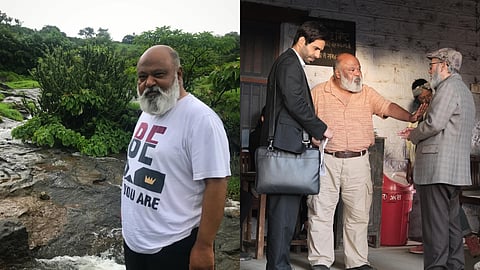

Saurabh Shukla, actor and writer of the cult-classic Satya (1998), refrains from taking up writing projects. He offers an expansive explanation. “See, writing is a long, arduous process. It begins in an empty room and ends when the film releases,” he says. “Moreover, writers don’t make money.”
He also considers writing as a pure thing, something that “really takes a lot out of you.” “That’s why I never took it up as a profession,” he says. “When you write something, you completely own it. The good, the bad, it’s all yours. As an actor, if I don’t agree with the vision of my director, it’s okay, because I don’t own the piece. But as a screenwriter, if somebody tells me to think in a particular way, I am often not able to. It’s difficult to always agree with somebody else’s vision.”
This creative tussle between a writer and a director was resolved easily in Jab Khuli Kitaab, written and directed by Saurabh himself, starring Pankaj Kapur, Dimple Kapadia, and Aparshakti Khurana. The slice-of-life comedy revolves around Gopal ji (Kapur) an old man who is seeking divorce from his wife Anusuya (Kapadia) who has recently awakened from a coma. Aparshakti plays the unlucky lawyer tasked with finalising this separation. The story was first presented as a play. “As a film professional, whatever I write, I envision it as a film only,” explains Saurabh. “But then the theatre festival Aadyam offered me to do a play, and since the idea was in my head, I thought, why not experiment with it and write it as a play and see how far I can take it. It also helped me understand what I wanted to say via this story. The play got a good response and attracted Applause Entertainment to back it as a film.”
Saurabh shares that, while writing, he had Pankaj Kapur in mind because he needed his cinema and life experience, but Dimple wasn't his go-to choice. “My business partner, Naren, suggested her name, but I was like, she is such a big star, would she even have time to do this? Still, on his insistence, I sent the script and then waited for her secretary to call and refuse,” he says. “I did get a call, but from Dimple ma’am herself, saying in an assertive tone, ‘Saurabh ji, I have read the script. This role would be done by me and nobody else.’”
Aparshakti, a law graduate himself, plays a struggling small-town lawyer in the film. “The first thing Saurabh sir told me was not to do what I would have done in my law days,” he says with a loud laugh. “During workshops and script readings, we cracked that this character is a struggling lawyer and thus needs a sense of desperation in his body language, in his eyes. And then you need an opposite reaction because when he gets the case, it is of divorcing an old couple, and he wants to lose it.” Aparshakti adds that working on the film gave him a golden opportunity to collaborate with veterans like Kapur and Kapadia. “I have grown up watching Pankaj sir’s performance in Phatichar (1991). I still remember Dimple Ma’am’s steps in 'Tera naam liya' from Ram Lakhan (1989). Actors like me are in this city, working in creative fields, because these veterans inspired us. I was nervous to perform in front of them, but then Saurabh sir ensured that the set had an environment where everybody was an equal.” Praising Aparshakti, Saurabh says the actor understood both the character and how to perform it. “I have no qualms about saying this, but had I given Aparshakti some other role in the film, he would have done an equally good job in performing it.”
As both an acclaimed actor and writer, Saurabh also has an interesting philosophy on characters. He states that his experience reading and performing classic plays during his theatre days taught him a fundamental lesson about characters. “An interesting character is the one who has a flaw,” he says. “Flawlessness is like a beautiful musical note, but if you keep hearing it over and over again, it can get one-note. That's why I love flawed characters, both while acting and writing. As a viewer, you yourself are not complete, and that flaw, that lack in a character on screen, makes them human. Ultimately, we all love watching human stories.”
