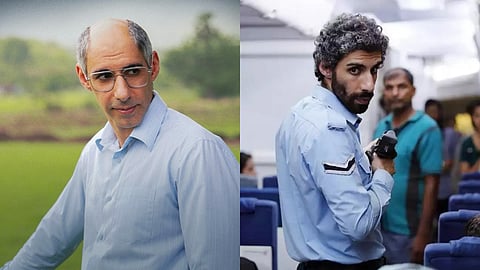

After his turn as nuclear physicist Homi Jehangir Bhabha in Rocket Boys (2022-2023), Jim Sarbh is back playing a historical figure in a web series. He delivers a nuanced performance as watch manufacturer Titan’s MD, Xerxes Desai, in Amazon MX Player’s Made In India: A Titan Story. One of the delightful aspects of the series is how Jim Sarbh gets the subtle nuances of his character right. For example, he calls a Tata executive ‘Mr Singh’ during a presentation, only to switch back to ‘Sir’ in the very next moment and then again to the former. When he feels confident about the presentation, ‘Mr Singh’ comes out of him naturally, but any doubt in him regarding its success makes him switch back to the more formal salutation. Agreeing with this assessment, Jim Sarbh shares, “What I like about Xerxes and what I think that we have managed to portray throughout the series is that however familiar he is with anybody, he understands the power dynamics and is very respectful of the hierarchies at Tata.”
This hierarchy is most evident in the relationship between Xerxes Desai and his close friend cum Tata Group chairman, JRD, (Naseeruddin Shah). As Jim explains, “Xerxes does not call him ‘Jeh’ in front of the Board or anybody else at Tata. Anyone who might call him Sir, he also addresses them the same when they are in front of those people. He only calls him Jeh when they are around Pinks (Rupali Arte) or are having a one-on-one.”
Jim Sarbh opines that this attention to detail makes Made In India: A Titan Story an authentic exploration of corporate culture. He adds that the aforementioned is not too different from the dynamic between an actor and a director on the set. He explains, “If you have a certain kind of a relationship with the director where you can speak very affectionately to them in one regard, you do not want others to think that you are not taking their job seriously though. So there are some times where you adopt a more classic tone, which includes ‘Sir’. So similarly here, I think he starts on the familiar and then as soon as he is receiving pushback, he returns to the formal and the polite.”
Speaking of pushback, playing a historical figure may come with a certain amount of baggage, especially if it is one as influential as Titan’s managing director. However, Jim shrugs off the notion and reveals, “More than anything, I feel the pressure that I should represent what my character represents and do the job he should do in the series or the film. I want to do it in such a way that the audience connects with it, finds it exciting, follows its journey or is moved by it. Whatever is required in the overall context of the story. I feel that pressure for every part, not necessarily more for real people.”
This does not mean that Jim was not cognizant of the consequences of a portrayal that fails to live up to the real-life stakes. “Of course, there is the idea that yes, this is a great person. And yes, it could go wrong. And if it goes wrong, it will not be good and it would end up being a poor representation of a great person. However, I try not to worry about all that,” Jim shares before adding, “Instead, I try to concentrate on bringing forth the character and what they represent in the overall story.”
Jim is also a big believer in doing extensive preparation before entering the set. He had countless discussions with Made In India: A Titan Story director Robbie Grewal and constant back-and-forth with its writers. “It is always tricky with a director because they have to concentrate on so many things, including production design, story as a whole, costume, framing, and lighting. All these hundreds of things. Whereas me as the actor would come in selfishly looking at my part. ‘What is my part going to be?’”
For Jim, actors add colours to the ingredients in the screenplay and bring the characters to life, but the writers and the director lay the groundwork. Crediting his team, he states, “As Robbie was saying the other day, the film is made before you even get to the set. Once you get there, you are coloring it all in, but essentially you should work out the film beforehand. And I think Robbie and the writers were very generous with me, and we all worked together to create this character. Of course, many scenes were just already fantastic as they were. And it was just about playing them out with suspense and honesty.”
Another interesting aspect of the series is the mentor-mentee relationship between Xerxes and JRD Tata. In a recent conversation with CE, Made In India: A Titan Story writer Niraj Dasa revealed that Xerxes turns megalomaniacal at one point in the show, but Jim disagrees with this notion, citing Xerxes’ apology to his team for the failure of Titan in Europe as an example of his weakness and ambition. “One of the lovely things about the mentor-mentee relationship is that JRD gives much autonomy to Xerxes. He makes it clear that now is not the right time to go to Europe, but Xerxes differs with him. And JRD tells him, ‘You are the MD of Titan. It is your company. So please go ahead.’ This is a very important and interesting aspect of their relationship, which is you have to let your mentee make mistakes. You cannot protect them from everything. You have to let them follow their instinct. Even if it may lead them in the wrong direction, this will help strengthen their instinct for the future.”
Made In India: A Titan Story has been drawing much appreciation from critics and audiences. For example, Scam 1992: The Harshad Mehta Story creator Hansal Mehta has called it “a perfect feel-good series for a world that often feels grim and hopeless.” This is partly down to how the series advocates for celebrating failures. Addressing the real-life practicality of this motto, Jim shares, “It depends on the scale of your situation. Is it a setback? Is it something that you can overcome? Do you have the wherewithal, the capital, the potential to overcome failure?” He adds, “As it pertains to the show, the spirit of the idea is never let a failure be something that sets you back or makes you give up. You strive forward through it. As Xerxes himself says, if you celebrate it, it is easier to accept it. And once you accept it, it is easier to grow. No matter what your socioeconomic situation is, if you dwell on an act of failure, you are never going to move forward.”
Notably, Hansel Mehta also called Made In India: A Titan Story a “hagiography”. However, Jim differs from this perspective, saying, “It is up to you to decide whether it is a hagiography or not. The makers tried to be true to the real experiences that they had while they went and interviewed members of Titan. When you go to Hosur and meet the people who work there, you will realise that they are all happy, full of attention, care, wit and intelligence. You speak to people, they say, ‘We have been here for 15-20 years.’”
Jim adds that the employees stayed with Titan for years because the company values them, pays them well, and treats them with respect. “I wondered whether they do not want to move on and do something bigger, while drawing from the experience of having worked there. However, they were like, ‘All of the values that the company claims to uphold, they actually do. So why would we want to leave?’”
A series about the making of the Titan watch brand, Made In India: A Titan Story has come ten years after Jim’s debut with Neerja (another based-on-real-life story). On whether he would go back in time and give a piece of advice to his younger version from 2016, the actor shares, “I do not really think too much about the past or the future, to be very honest. I kind of like to just flow with whatever's happening in the moment. The Jim back then did the best that he could do. Further, advice can only be taken by people who understand it. So my advice may not have been understood by the young Jim. You have grown and evolved as years have passed, as you should naturally. And I hope that in 10 years, we can reflect on Made in India happily.”
