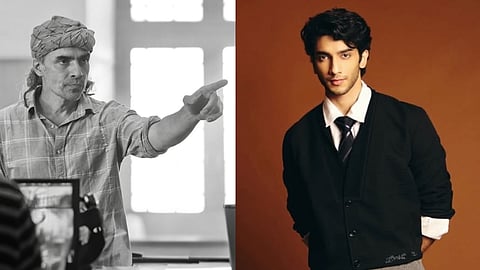

Every story for Imtiaz Ali has begun with a key visual. It’s not surprising that in Main Vaapas Aaunga, his latest film which deals with partition and star-crossed lovers, the train was a key motif, an origin point. Imtiaz elaborates, “I had this image of a guy on a train, looking back at the land he is leaving behind. He is trying to communicate, ‘I will return.’ Sometimes, these visuals don’t have a definitive form, but there is a feeling to them. Here, it was the sentiment of going back, that something is being taken away from him.”
Vedang Raina, who made his debut with The Archies (2023), plays this man in question. Throwing light on his character, Keenu, Vedang says, “He is more of an athlete but wants to be one of the intellectuals. He aspires to be a poet but is not very good at it. I had to be aware of that period, of the cultural influences on him.” Vedang also credits his director for giving him little nuggets that helped him build the character. He adds, “Keenu is a guy who speaks before thinking. He doesn’t process things much. Imtiaz sir was mindful of telling me this because he thinks I am the other kind. He (Imtiaz) thinks a lot before he speaks and I do, too. So, it was a challenging experience and also exciting — to play a character so far away from who I am as a person.”
Vedang plays the younger version of Naseeruddin Shah’s character in the film. The Jigra actor recalls meeting the stalwart, noting, “I have always seen him as this masterclass. When I was trying to get into acting, I’d watch a lot of his acting class videos at NSD. When Imtiaz Sir once invited me to his house, I went with a notebook and pen, which is a rather odd thing to do. I was quite intimidated by him. But I remember he told me to read a book on acting, which I eventually did.”
With films like Jab We Met (2007), Love Aaj Kal (2009), and Rockstar (2011), Imtiaz has given a new direction to the romance genre in Hindi cinema. While there has been a genuine dearth of rom-coms and love stories in the past few years, the director doesn’t sound worried. It’s an age-old pattern, he insists, adding, “I don't think anything has changed. I remember very well the ‘90s, the 2000s and so forth. It always happens that there is a spurt of a certain kind of movie and then comes along a love story — if it’s good, people really give their hearts to it.” Recalling iconic films like Ek Duuje Ke Liye (1981), Maine Pyar Kiya (1989) and Qayamat Se Qayamat Tak (1988), the filmmaker says, “At that time, nobody knew Aamir or Salman, but these movies were loved nonetheless. The point is, you can’t make love stories in a factory. It has to come from a place of feeling. That’s why they come once in a while,” he adds with a smile.
Imtiaz also talks about his sense of responsibility as a filmmaker, which comes from his early years as a film-lover. He explains, “As a young man who got influenced by cinema, I feel others should not get influenced by my cinema in a way that is wrong. Besides smoking, there are other things that are not obvious but more ethical or moral. I don’t want to hurt anybody. I think every filmmaker is aware of a certain responsibility they bring to their films.”
While Vedang was appreciated for his work in The Archies, the film also drew backlash for its debutant star-kids. His next film, the Alia Bhatt starrer Jigra (2024), a big-scale thriller, didn’t live up to the box office expectations. When asked how he dealt with the mixed reactions, Vedang says he chooses to look at it positively. “To be in a film and watch my face pop up on TV was already the biggest achievement of my life. I didn't even realize when Jigra happened. Suddenly people were like, ‘okay, but box office?’” I was also young, and couldn't entirely process these things. These things were too big for me,” Vedang states, adding, “The only thing that feels bad is I wish more people saw what we worked on for 1.5 years. But I've also received a lot of love and that keeps me going. I am grateful for both these opportunities, because I can't see it any other way.” Imtiaz interjects at this point to thank Vedang’s first two directors — Vasan Bala and Zoya Akhtar. He elaborates, “By the time Vedang came to my sets, I could see no negative influences. He was in a very good condition when I met him. I feel Zoya did a lot of pre-work which is going to stand all these actors, who worked in The Archies, in a very good stead.”
Main Vaapas Aaunga also marks Imtiaz’s fifth collaboration with AR Rahman, who has delivered memorable soundtracks with the filmmaker in films like Rockstar, Tamasha (2015) and Amar Singh Chamkila (2024). With Rahman, it’s a case of mutual surrender, Imtiaz says, adding, “Rahman is more of a film man than a music man. He is always looking at the overall film. With every idea Rahman brings, he brings me in. He never says, ‘I am right, do this.’ He takes his ideas from the story, the director — which is why none of his film albums sound similar. The Taal soundtrack could never sound like a Rockstar album. We trust each other, and that’s how we discover new things.”
Besides Rahman, Imtiaz has also had a strong emotional connection with Punjab, which has been reflected in many of his works like Jab We Met, Love Aaj Kal, and Amar Singh Chamkila. However, with Main Vaapas Aaunga, the filmmaker takes it a notch higher, revisiting a very significant chapter of their history. “The 1947 partition is perhaps the most brutal yet influential incident in the Indian subcontinent, more than any other war, disaster or triumph. But when people went from one side to the other, they also carried their hopes, memories, longing and beautiful things. Whenever I have been in Punjab, I have heard these stories so often, of love and tenderness, that I found it imminent to make this film. Main Vaapas Aaunga belongs to the people of Punjab and Bengal, and we wanted that, before the last standing generation who saw Partition passes away, this film comes out,” he says.
