
They say that if you do what you love, and love what you do, you will never work a day. But that is one big myth that continues to be propagated every single day. Look at how creative professionals are experiencing a type of exhaustion as they are selling a piece of their identity alongside their craft.
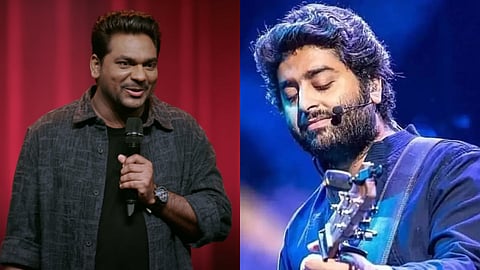
When a standup comedian such as Zakir Khan admits to burnout or Arijit Singh finds playback singing boring, due to the technical exercise of repeating tunes, it dismisses the illusion that artists are fundamentally different from those with 'regular' jobs. These are two of India's most popular artists in their respective realms, and their recent announcements have been sending shockwaves among art lovers across the nation. While Zakir is likely to come back to stand-up comedy a few years later, Arijit Singh's decision to quit playback singing seems to be final.
We tend to idolise artists and put them on a pedestal instead of viewing them as regular people, and this is the kind of trap that the attention economy leads us to. For example, the key to Zakir's success lies in how he has been maintaining a particular persona in his comic acts. As Zakir once told Amitabh Bachchan, the whole ‘Sakht Launda’ bit is a ‘campaign’ that entails projecting strength and masking vulnerability at the same time. When it comes to the idea of romance, ‘Sakht Launda’ refers to a man who is strong enough to keep himself from falling for any romantic advances to him. They think they do not need love and project an image accordingly. Maintaining such a persona can seem like an exhausting task, albeit in a stand-up comedy format.
Zakir Khan is not just telling jokes; he is covering up vulnerability under the facade of being infallible, which itself can contribute to a performative exhaustion. This exhaustion does not apply only to comedy. In music, Arijit Singh faces a similar grind. For many musicians, repetitively working on similar tunes, much like Arijit has been doing, means relying more on your muscle memory than your creativity, which in turn can dilute the joy of creation.
Further, the consumption of art nowadays, with digital platforms, means that you get validation and response way quicker than ever before. For artists, it also means greater competition and having to come up with something new every now and then to stay relevant.
Back in the day, artists could afford to release a standup special or an album, go on a tour with it, and go away for years while collecting new materials and ideas for inspiration in the process. Today, however, they can no longer afford this 'incubation period', because if they use it, it would affect their fanbase or social media reach significantly. The consequence? Burnout and monotony.
In many ways, whether or not they know it, the likes of Arijit and Zakir are merely responding to the demands of an economy where the only things that matter are the likes, shares, views, streams, and other factors of the algorithm. Zakir is not the first standup to feel the burden of having to keep up with the so-called attention economy's demands, making their old material age faster.
Russell Peters serves as an example of how the internet can both create an overnight sensation and gradually drain them. Also known for his cameos in films, such as Source Code, Peters shot to fame thanks to a fan clip on YouTube. He even made humour out of people's tendency to watch his standups through pirated sources, because it only made him popular. However, with the change in times, there has been more discourse over the same cultural taboos and stereotypes that Peters used in his performances and that made him famous in the first place. This is to say, the attention economy requires not just content on a frequent basis but rather evolving content.
As an artist, if you do not keep evolving as fast as the trends change online, you run the risk of being obsolete. Unfortunately, today's artists, no matter who they are, cannot afford such ways of working where they maintain a distance with the audience. They have to be participants in the attention economy, a system that thrives on engagement, and no matter how much of a 'Sakht Launda' you are... it might just get to you.
